
Food Packaging
October 2026 | 13 min read | By ChromaPack Engineering Content
Short answer: Adding a clear transparent window to a stand-up pouch increases consumer conversion on retail shelves, but it introduces an unavoidable barrier penalty:
- The oxygen and moisture trade-off: Replacing an aluminum foil barrier (OTR < 0.05 cc/m²/day) with a standard transparent PET/PE window increases oxygen transmission by over 1,000× (OTR jumps to 50–100 cc/m²/day), potentially cutting sensitive product shelf life by 50% to 75%.
- The UV light threat: While high-barrier clear films like EVOH or AlOx restore oxygen and moisture protection, they remain transparent to UV and visible light (200–500 nm). Products rich in unsaturated fats (nuts, seeds, whole milk powders, roasted coffee) suffer rapid photo-oxidation, rancidity, and flavor degradation under retail supermarket LED lighting.
- The strategic verdict: Never use clear windows for whole-bean coffee intended for 12+ month distribution or sensitive nutritional powders. For premium snacks, dried fruit, or pet treats where visual texture drives the impulse purchase, use high-barrier clear laminates (PET-AlOx / EVOH-PE) or bottom-gusset windows, keeping shelf life targets within 6 to 9 months.
For the underlying barrier-layer physics of these substrates, see aluminum foil vs metallized PET vs EVOH pouches.
1. The Commercial Dilemma: Appetite Appeal vs. Barrier Physics
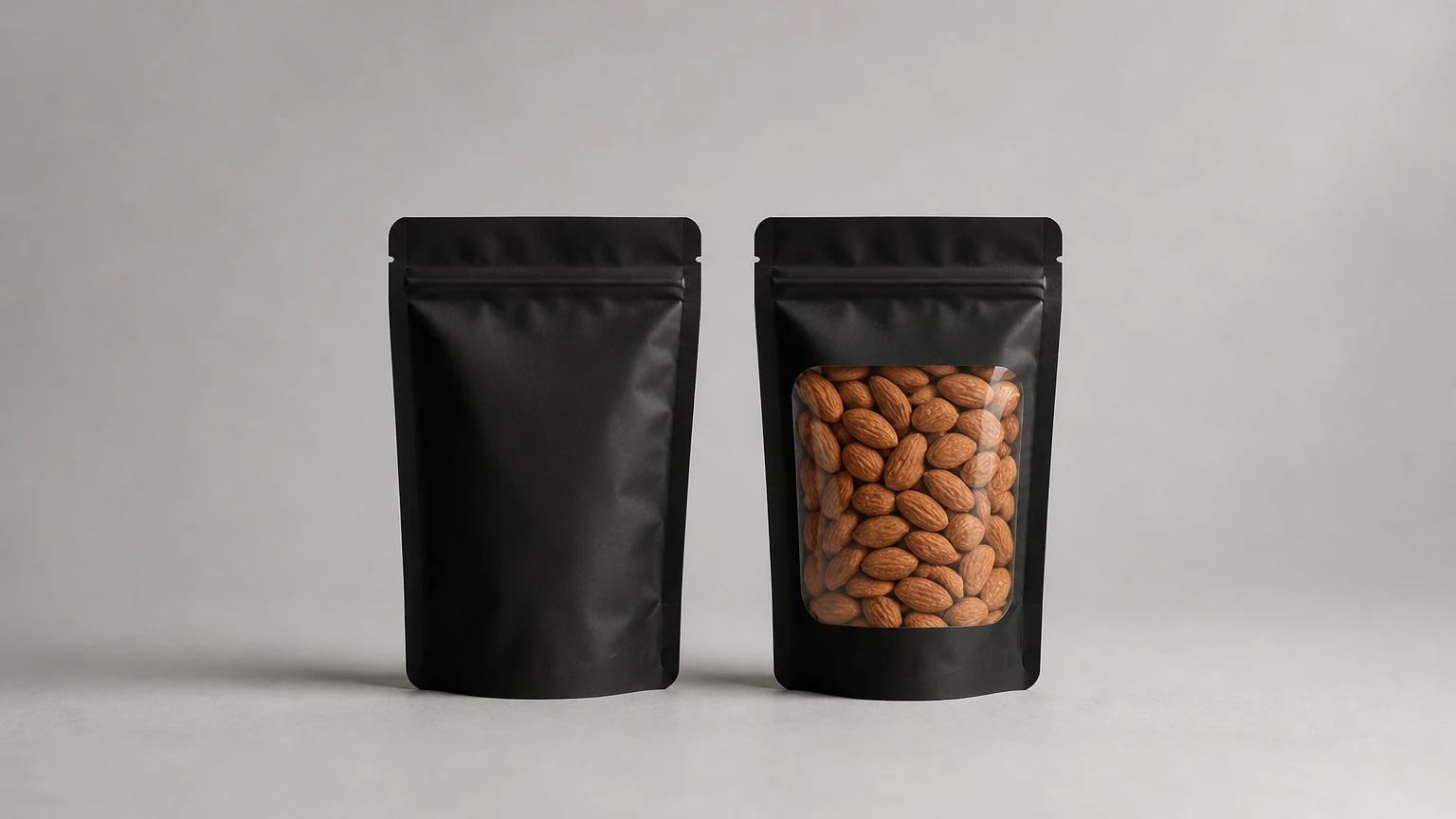
Consumer behavior research consistently confirms that transparency drives purchase intent. When consumers can physically see the golden roast of a nut, the vibrant color of dried mango, or the rich texture of gourmet pet treats, trust surges and retail conversion rates climb.
However, packaging engineers view a clear window through the lens of thermodynamics and polymer physics: every square centimeter of unshielded clear film represents a potential leak in your product's barrier envelope. Understanding exactly how much shelf life is traded away requires analyzing three interdependent degradation vectors: oxygen transmission rate (OTR), water vapor transmission rate (WVTR), and photochemical light oxidation.
2. Barrier Transmission Comparison: Foil vs. Metallized vs. Clear Films
To evaluate the true barrier cost of a clear window, we must compare the transmission rates of standard multi-layer flexible packaging substrates tested under identical standardized laboratory conditions (ASTM D3985 for OTR and ASTM F1249 for WVTR):
| Substrate Structure | Barrier Type | OTR (cc/m²/24h) at 23°C, 0% RH | WVTR (g/m²/24h) at 38°C, 90% RH | Light Transmission (200–800 nm) | Typical Shelf Life Potential | | :--- | :--- | :--- | :--- | :--- | :--- | | PET / AL foil / LLDPE (7–9 μm aluminum foil) | Total physical block (full barrier) | < 0.05 (near zero) | < 0.05 (near zero) | 0.0% (100% light proof) | 18 – 24+ months (maximum stability) | | PET / VMPET / LLDPE (vacuum metallized PET) | Vapor deposition (high barrier) | 0.8 – 1.5 | 0.5 – 1.2 | < 1.0% (reflective block) | 12 – 18 months (standard mylar) | | PET-AlOx / EVOH-PE (aluminum oxide coated) | Clear ceramic coating (high-barrier window) | 1.0 – 2.5 | 1.5 – 3.0 | 85 – 90% (fully transparent) | 9 – 12 months (premium clear) | | PET / EVOH / PE (co-extruded EVOH film) | Polymer gas barrier (moisture sensitive) | 1.5 – 3.5 | 4.0 – 6.0 | 88 – 92% (fully transparent) | 6 – 9 months (moderate protection) | | Standard clear PET / LLDPE (budget commodity window) | Standard polyolefin (basic window) | 80 – 110 | 12.0 – 18.0 | > 92% (unfiltered light) | 2 – 4 months (rapid degradation) |
Critical takeaway: Standard budget clear windows (PET/PE) allow roughly 1,000× more oxygen ingress and 200× more moisture transmission than an aluminum foil pouch. If you use a commodity clear film, you are not slightly trimming shelf life—you are transforming a hermetic container into a permeable bag.
For the wider barrier-property and food-safety picture behind these films, see barrier properties of custom flexible food pouches.
3. The Invisible Destroyer: Photo-Oxidation Under Retail Lighting
Many brand owners assume that by specifying premium clear barrier films like AlOx (aluminum oxide) or EVOH, the shelf life penalty disappears. This overlooks the silent killer of packaged foods: photochemical lipid oxidation.
Mechanisms of Light-Induced Spoilage
- Free radical cascade: Ultraviolet radiation (290–400 nm) and high-energy visible violet light (400–450 nm) penetrate clear windows and excite sensitizers (such as naturally occurring chlorophyll, riboflavin, or residual oxygen molecules) into singlet oxygen states. This triggers rapid oxidative rancidity in unsaturated fatty acids.
- Peroxide value and off-flavors: Even in a high-barrier pouch with low residual headspace oxygen (<1.0%), incident light catalyzes the oxidation of free radicals into hydroperoxides. Over 30 to 60 days on supermarket shelves (typically lit at 800–1,200 lux), this creates pungent aldehydes and ketones (cardboard-like, stale, or metallic off-notes).
- Pigment fading and nutrient loss: Natural carotenoids in dried fruit, lutein in functional powders, and delicate coffee roast aromatics bleach and degrade under continuous fluorescent or LED retail lighting, ruining the visual appeal that the window was intended to highlight.
Roasted coffee is the clearest example of a product where a window works against the product itself. Our coffee bag materials guide for roasted beans covers which structures actually hold aroma.
4. Product Risk Matrix: Which Goods Can Tolerate a Window?
Before finalizing dielines and window placement, map your product against ChromaPack's empirical sensitivity matrix:
| Product Category | Primary Spoilage Vector | Window Feasibility | Recommended Packaging Architecture | | :--- | :--- | :--- | :--- | | Specialty roasted whole bean coffee | Aroma loss, staling, CO2 degassing, lipid photo-oxidation | High risk (not recommended) | 100% opaque aluminum foil (PET/AL/PE) with one-way degassing valve. Never use front windows. | | High-oil nuts and seeds (walnuts, macadamias, pine nuts) | Polyunsaturated fat rancidity, off-odors, texture softening | High risk (conditional) | Full metallized pouch or high-barrier AlOx film with a small bottom window; nitrogen flushing required. | | Gourmet pet treats and jerky (low-fat meat strips, biscuits) | Moisture absorption, microbial growth, protein oxidation | Moderate risk (acceptable) | PET-AlOx / LLDPE high-barrier clear film. Target a 9-month shelf life with active desiccant/absorber. | | Dried fruit, granola and candies (low-fat confectionery) | Sugar blooming, moisture hardening or softening, pigment fade | Low to moderate risk (highly feasible) | EVOH / PE or AlOx pouch. A front die-cut window is commercially viable for 6–9 month turnover. | | Organic pastas, beans and grains (dry legumes, lentils) | Insect vulnerability, moisture uptake, starch hardening | Low risk (standard practice) | Standard clear PET / PE or mono-PE. Full transparency causes negligible spoilage over 12 months. |
5. Engineering Compromises: 4 Smart Architectural Workarounds
If brand marketing mandates visual appetite appeal, but quality engineering mandates product protection, four structural workarounds achieve a reliable compromise:
Strategy 1: Bottom Gusset Transparent Window
By engineering the front and back panels with 100% opaque aluminum foil (PET/AL/PE) and utilizing a transparent high-barrier laminate solely on the bottom gusset, retail lighting cannot penetrate the pack when standing on a shelf. Shoppers can physically inspect the product by lifting the pouch, while the contents remain shielded in 90% shadow during storage.
Strategy 2: Registered Demetalization on VMPET
Instead of laminating separate clear plastic films, high-precision chemical etching demetalizes a specific geometric shape (for example, a slim 25 mm horizontal slit or an organic die-cut shape) on a metallized PET web. The surrounding metallized barrier remains 100% intact right up to the crisp edge of the window, preserving maximum overall barrier area.
Strategy 3: AlOx Coating with UV Absorber Masterbatch
Transparent aluminum oxide (AlOx) ceramic-coated PET provides high barrier performance (OTR < 1.5 cc/m²/day, WVTR < 1.5 g/m²/day). By compounding an organic UV-absorber additive into the sealant PE layer, the window blocks 95%+ of light wavelengths below 390 nm while maintaining over 85% visible clarity.
Strategy 4: The 15% Surface Area Rule
Total gas transmission into a package scales proportionally with the surface area of the weak barrier. Limiting window dimensions to under 15% of the total front panel area ensures that 85%+ of the pouch continues to function as a high-performance barrier.
Frequently Asked Questions
Can I package roasted whole-bean coffee in a pouch with a clear window? We strongly advise against it for retail grocery distribution. Roasted coffee contains delicate volatile aromatic oils that go stale rapidly under ambient light and oxygen exposure. If a window is commercially essential, use an AlOx clear barrier structure with nitrogen flushing, incorporate a degassing valve, and restrict your distribution shelf life to under 90 days.
Does nitrogen flushing make a clear window pouch safe from oxidation? Nitrogen flushing lowers the initial residual headspace oxygen (often down to <1.0%), which substantially delays oxidation. However, if the clear window substrate has a high OTR (like standard PET/PE), oxygen will permeate back into the pouch within 4 to 8 weeks, neutralizing the inert gas protection. High-barrier clear films (AlOx or EVOH) are mandatory if nitrogen flushing is used.
Are high-barrier clear windows fully recyclable? Mono-material structures using MDO-PE laminated to EVOH-PE (mono-PE) provide high clarity and acceptable gas barrier while qualifying for standardized RIC 4 PE recycling streams. Unlike multi-material PET/AL/PE foil laminates, modern mono-material clear pouches are widely recyclable in European and North American municipal programs.
How do I calculate the exact shelf life loss for my specific product? Shelf life loss cannot be calculated through theoretical formulas alone because food water activity (aw), fat composition, and ambient retail temperatures vary. ChromaPack provides accelerated shelf life testing protocols (typically 40°C at 75% RH over 90 days) comparing peroxide values and moisture gain across opaque foil versus prototype window bags.
Request Barrier Samples for Your Pouch Project
To quantify the trade-off against your actual product, request a custom barrier packaging sample kit and include:
- Product type and its dominant spoilage vector (oxidation, moisture, or light).
- Target shelf life and distribution channel (retail shelf versus e-commerce).
- Required window area and placement (front die-cut or bottom gusset).
- Annual volume plus filling line capability (nitrogen flushing, seal initiation temperature tolerance).
Our pouch range and structural options are set out under custom stand up pouches, with volume and supplier considerations covered in the stand up pouches sourcing guide.
Authoritative Sources
- ASTM D3985: Standard test method for oxygen gas transmission rate through plastic film and sheeting using a coulometric sensor.
- ASTM F1249: Standard test method for water vapor transmission rate through plastic film and sheeting using a modulated infrared sensor.