
Custom Coffee Bags Guide: Materials, Valve Options & Printing for Roasters
Introduction
Whether you're a craft roaster shipping single-origin beans or a large coffee brand distributing nationwide, your coffee bag is more than just a container — it's a preservation system and a brand billboard. The wrong material can cost you freshness. The wrong valve can cause bag inflation. And the wrong print finish can hurt shelf appeal.
At ChromaPack, we produce millions of custom coffee bags each year for brands across North America, Europe, and Asia. In this guide, we break down exactly what you need to know before placing your order: materials, valves, MOQ, and printing technology.
See our full range of custom coffee bags and materials, or visit our coffee bag guide page for a quick overview.
1. Custom Coffee Bags: Materials That Keep Your Coffee Fresh
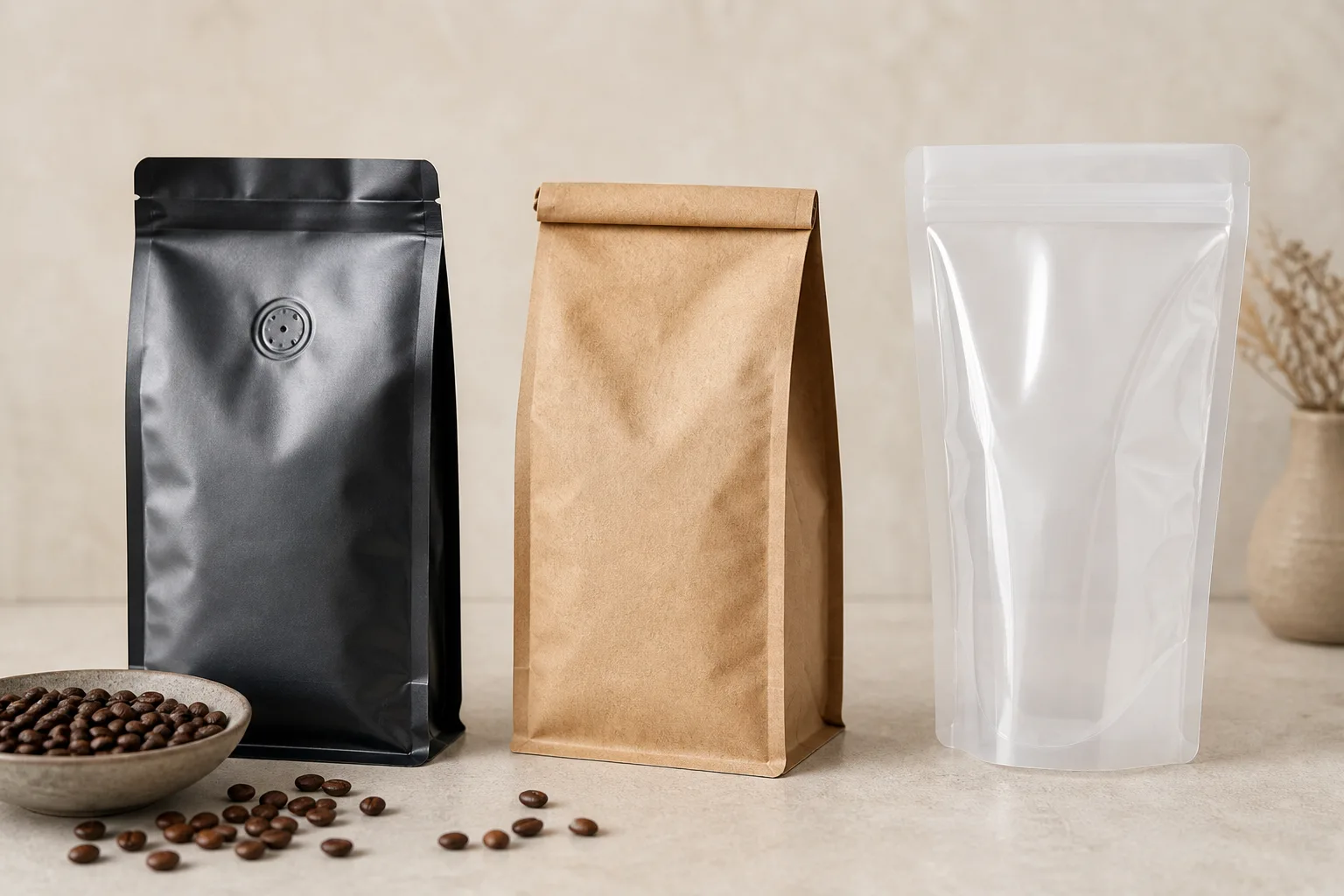
The material you choose directly impacts shelf life, protection from light and oxygen, and your brand's aesthetic. Here are the three most common choices for custom coffee bags:
Aluminum Foil Bags
Aluminum foil provides the highest barrier performance, protecting coffee from oxygen, moisture, and UV light. This is the go-to choice for freshly roasted beans shipped internationally or stored for extended periods.
- Best for: Long-shelf-life products, export shipments, high-end specialty coffee.
- Drawback: Slightly higher material cost — but the freshness protection often justifies the premium.
Kraft Paper Bags
Kraft paper delivers a natural, artisan look that resonates with eco-conscious consumers. While paper alone offers limited barrier, our kraft bags are available with an inner aluminum foil or PE lining for functional freshness protection with a rustic exterior.
- Best for: Small batch roasters, organic brands, sustainability-focused packaging.
- Drawback: Requires an inner barrier layer for effective freshness preservation.
Plastic Bags (Polyethylene / Stand-Up Pouches)
Lightweight and cost-effective, plastic stand-up pouches are a practical choice for bulk coffee or retail where cost-efficiency is the primary driver. Modern high-barrier PE films offer significantly improved protection compared to standard poly bags.
- Best for: Bulk orders, budget-conscious brands, single-serve portions.
- Drawback: Lower barrier performance than aluminum foil without additional lamination.
2. Coffee Bag Valves: Why They Matter for Freshness
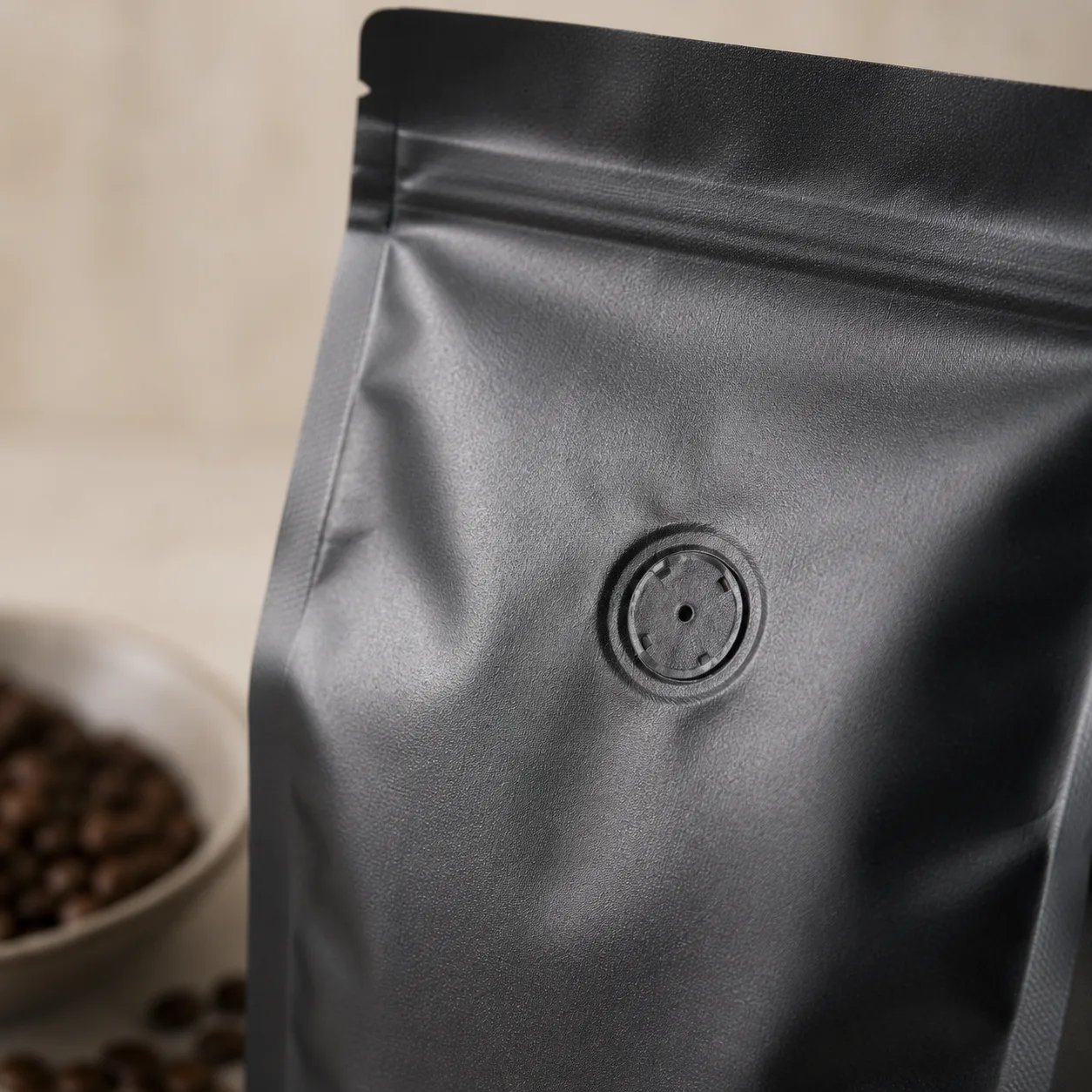
Freshly roasted coffee beans continue to degas CO₂ for days after roasting. Without a one-way valve, gas pressure builds inside the bag, causing it to inflate or even rupture. A one-way degassing valve allows CO₂ to escape while preventing oxygen from entering — keeping your coffee fresh on the shelf.
Standard One-Way Valve
The industry-standard solution. A small circular valve adhered to the inner film layer. Most common for kraft and foil pouches. Available in custom colors for branding.
Custom Aperture / Label-Integrated Valve
For premium branding, some bags integrate the valve under a printed label or use a color-matched cap. These add a custom look while maintaining full degassing functionality.
3. MOQ: What to Expect and How to Plan
Minimum Order Quantity (MOQ) is one of the first questions buyers ask. The MOQ for custom coffee bags depends on three factors:
| Factor | Low MOQ (1,000–5,000 pcs) | Standard MOQ (5,000–20,000 pcs) | Bulk MOQ (20,000+ pcs) |
|---|---|---|---|
| Material | Standard PE / Kraft | Aluminum Foil / Laminated | Premium Multi-layer |
| Printing | Flexo (1–3 colors) | Gravure / Flexo (full color) | Gravure (full color + effects) |
| Features | Basic zipper + valve | Zipper + valve + gusset | Custom shapes, spouts, windows |
| Per-Unit Cost | Higher ($$) | Moderate ($$) | Lowest ($) |
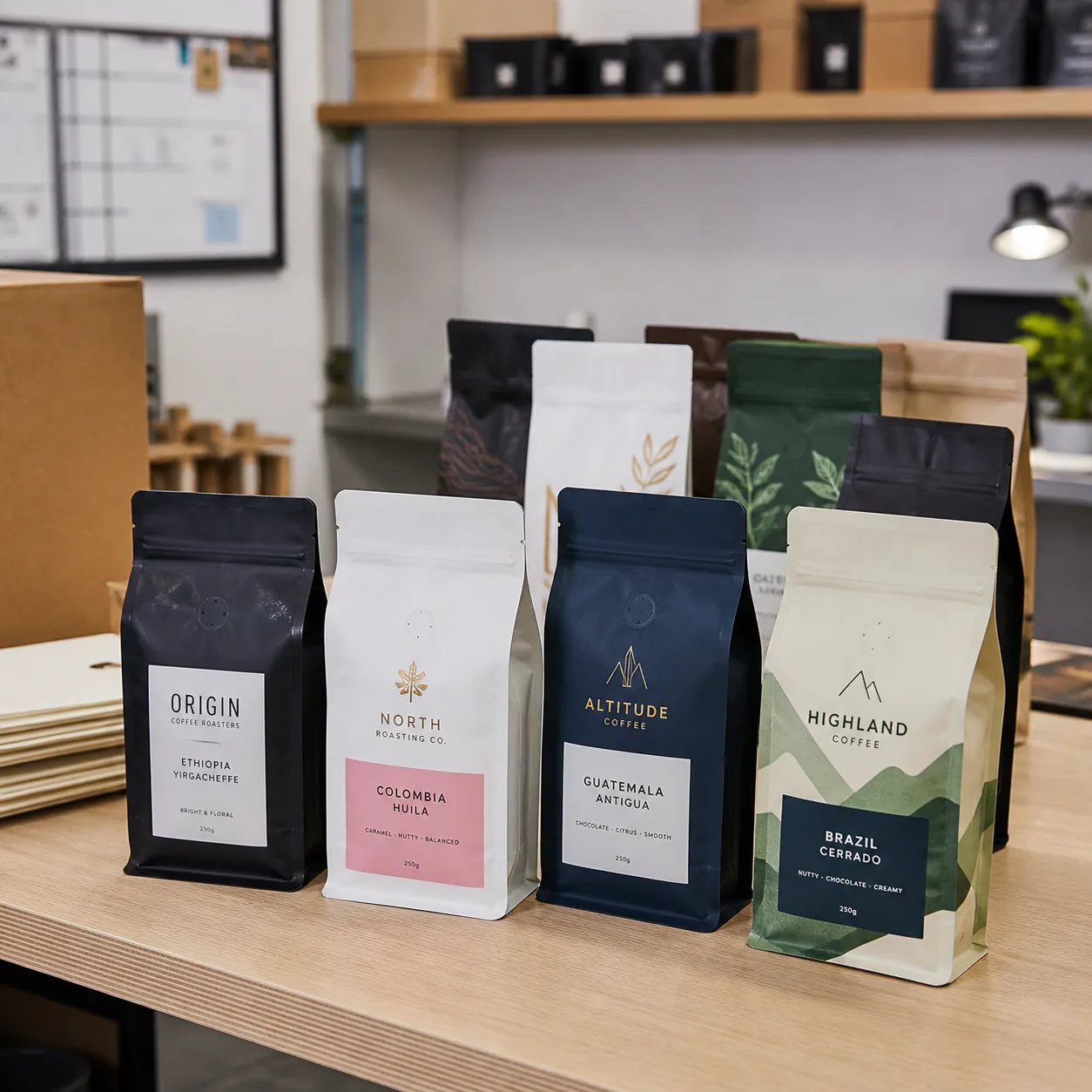
Planning Tip for Startups: If you're a small roaster testing a new blend, start with a flexo-printed batch of 1,000–3,000 bags. This minimizes upfront investment while still delivering a professional retail package. Once the blend proves itself, scale to full gravure production for lower per-unit cost.
At ChromaPack, we understand that roasters grow. We offer graduated MOQ structures so you can start small and scale without switching suppliers.
4. Printing Options: Personalizing Your Coffee Bags
Your coffee bag's print finish is your brand's first handshake with the customer. The right printing technology delivers consistent color, sharp detail, and durability across thousands of units.
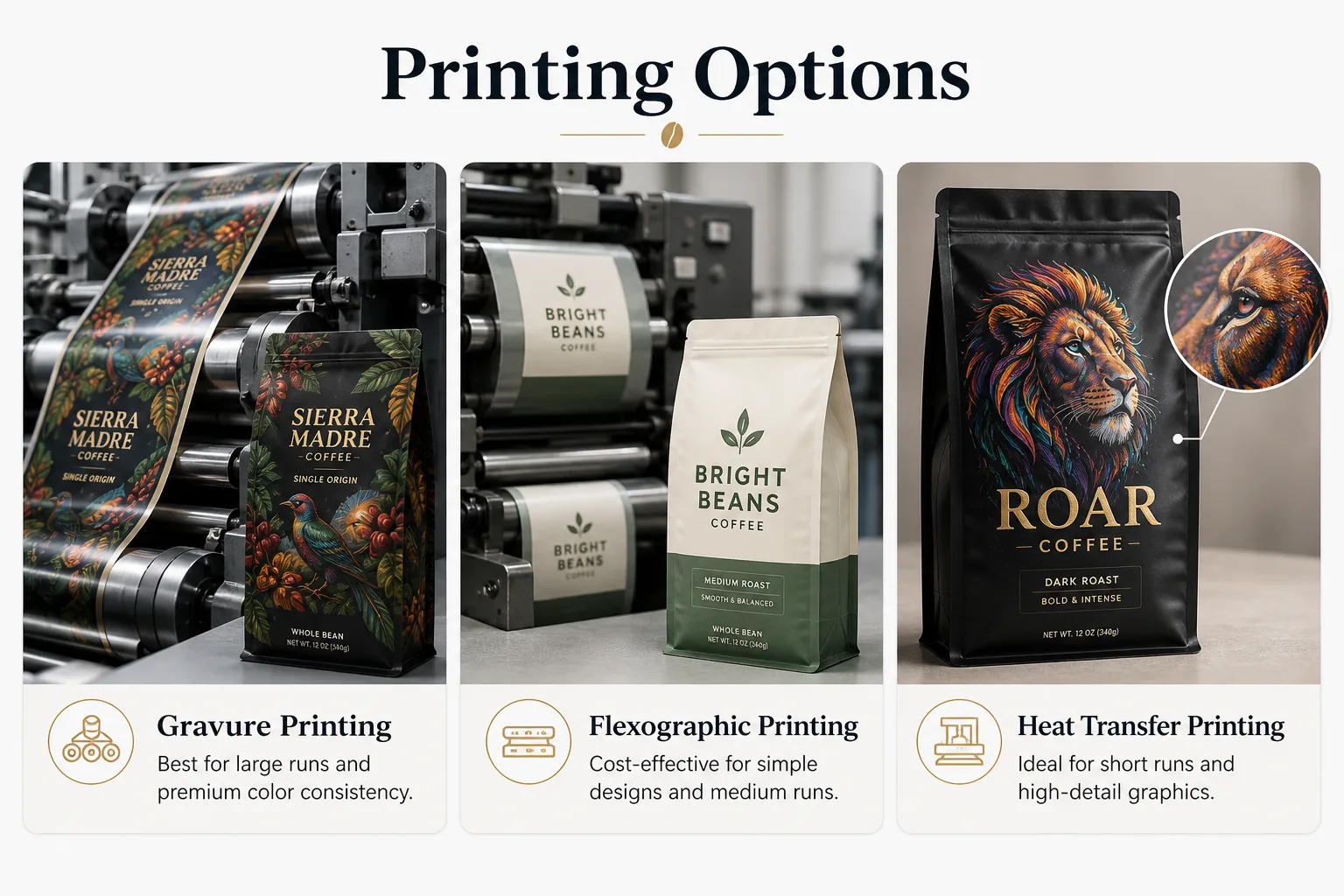
Gravure Printing
The gold standard for high-volume coffee bags. Gravure delivers deep, saturated colors with ±1% color consistency across the entire print run. Best for orders of 10,000+ units where brand color accuracy is critical.
- Best for: Large production runs, full-color designs, Pantone-matched branding.
- Available at ChromaPack: Up to 10-color gravure with real-time defect monitoring.
Flexographic Printing
A cost-effective alternative for shorter runs with simpler designs. Flexo is ideal for 1–4 color prints where speed-to-market matters more than ultra-high resolution.
- Best for: Small to medium batches, simple two-tone or spot-color designs.
- Drawback: Less suitable for detailed photographic or gradient-heavy artwork.
Heat Transfer Printing
For small runs requiring photographic detail or complex artwork, heat transfer delivers excellent resolution without gravure's setup costs. The design is printed onto a transfer film and then heat-pressed onto the bag.
- Best for: Premium limited editions, test runs, high-detail artwork.
- Drawback: Higher per-unit cost at very large volumes.
5. Conclusion and Call-to-Action
Custom coffee bags are more than packaging — they are your product's first and last impression. Choosing the right material, valve, MOQ structure, and print method determines whether your coffee arrives fresh, looks premium, and sells reliably.
At ChromaPack, we produce high-barrier, custom-printed coffee bags for roasters and brands worldwide. Our factory-direct model means you get better quality at a better price — with full compliance documentation for export.
Ready to Source Custom Food Packaging? Get material recommendations and free samples for your coffee bags, pouches, or food packaging project.
Get Material Recommendation Request Samples