
Material Science
November 2026 | 20 min read | By ChromaPack Engineering Content
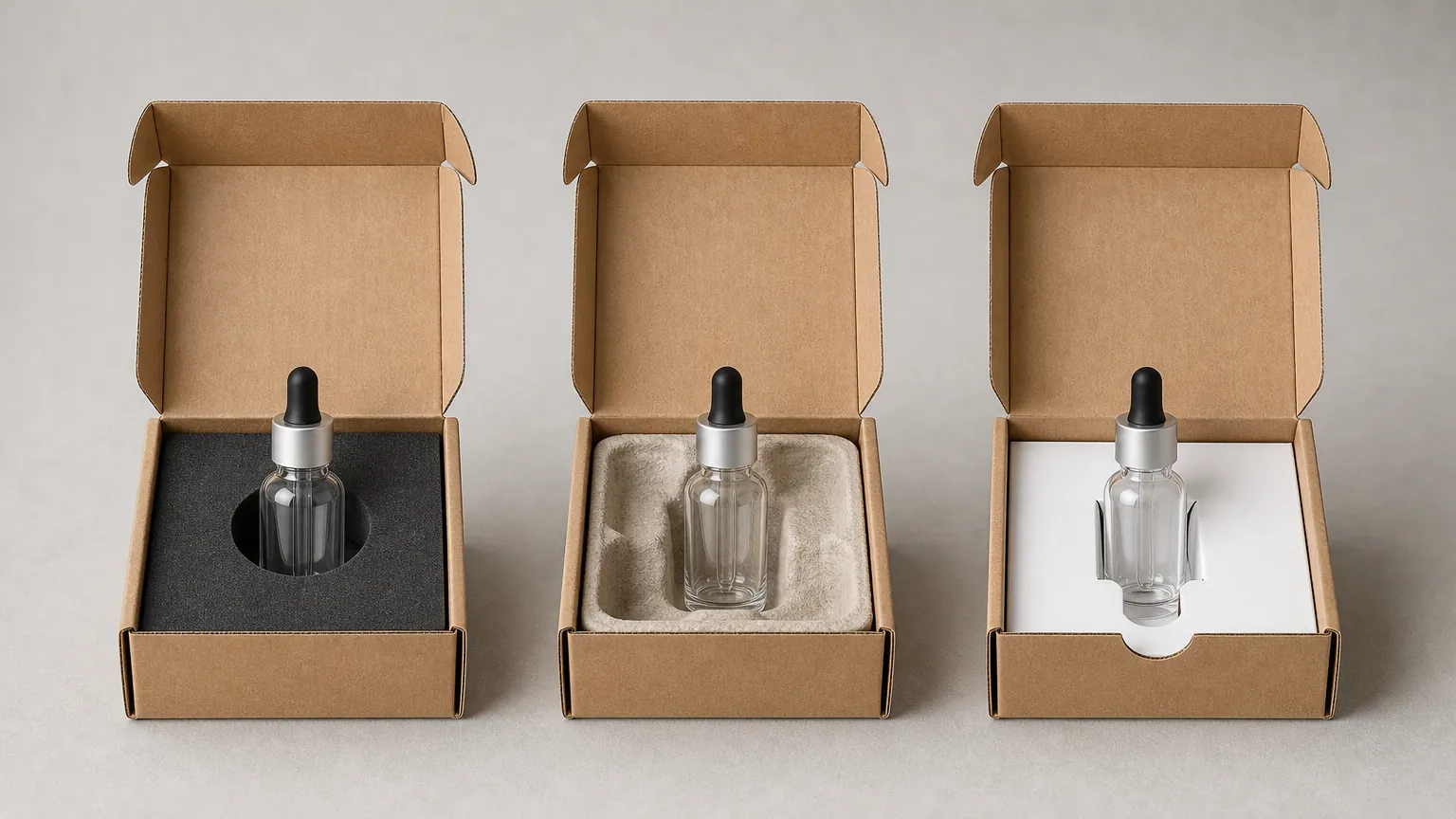
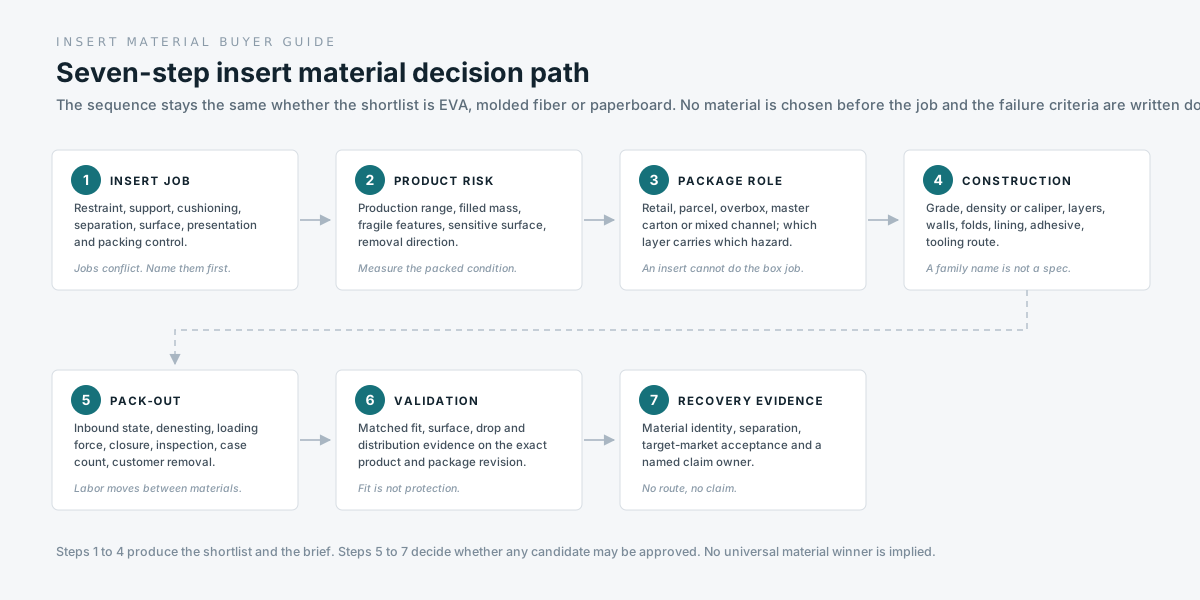
Short answer: Choose between EVA foam, molded pulp inserts and paperboard packaging inserts by comparing complete converted structures under the same product, outer box, packing operation, route and acceptance criteria. EVA can provide controlled cavities and cushioning, molded fiber can provide formed support and nesting, and paperboard can provide printed folded platforms, collars and partitions. None of the three is automatically the safest, the cheapest or the most recyclable. Confirm the exact grade, geometry, sample, pack-out and target-market recovery path before approval.
Decision rule: Define what failure looks like, assign each packaging layer a job, compare complete constructions rather than material names, then approve the material through matched physical and market evidence. A one-line material recommendation is not a production specification.
1. Define the insert job before choosing a material
The insert may need to hold position, carry static load, absorb or spread impact, separate products, protect a surface, present a premium opening view and make packing repeatable. Those jobs do not always point to the same material. A rigid cavity can control movement yet mark a coating. A paper platform can present beautifully yet transfer impact into a bottle base. A molded tray can nest efficiently yet require more draft, or a different removal path, than the concept drawing suggests.
Write the required job and the failure signal before anyone asks which material is best. The table below is the input sheet we ask buyers to complete before an insert quotation is worth comparing.
| Required job | Buyer must define | Evidence before approval | | :--- | :--- | :--- | | Restraint | Allowed movement, orientation and retention method | Representative product range seats and remains controlled | | Support | Load-bearing zones and prohibited load zones | No collapse, pressure mark or unstable seating under agreed conditions | | Cushioning | Hazard profile and product failure criteria | Matched package response under selected impacts and route tests | | Separation | Minimum product-to-product and product-to-wall clearance | No damaging contact after handling and validation | | Surface protection | Permitted contact material, pressure and rub exposure | No unacceptable scuff, transfer, dust, odor or residue | | Presentation | Visible face, color, texture and removal path | Approved opening view and customer handling | | Packing control | Assembly state, sequence, time and inspection point | Repeatable pack-out with recorded errors and labor |
A job list also settles arguments early. When a brand team asks for "a premium foam look" while the operations team needs a two-second load, the conflict is a job conflict, not a material conflict. Resolve it in this sheet.
2. Compare a complete construction, not a material label
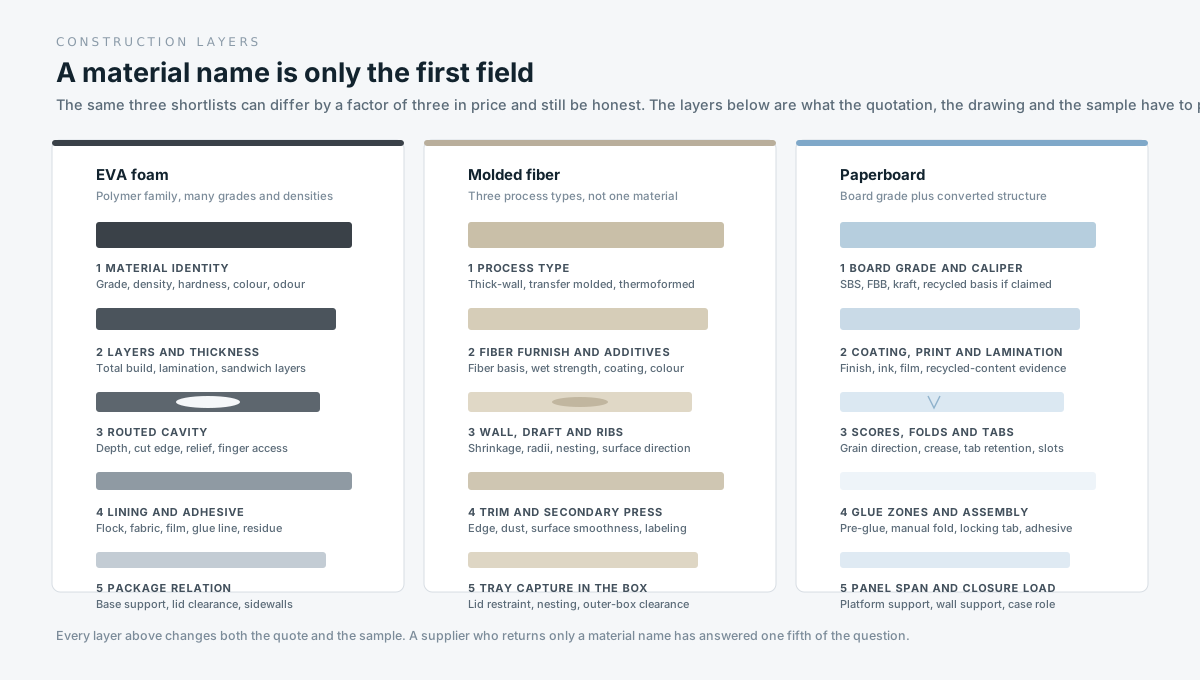
EVA, molded fiber and paperboard are families, not finished specifications. Protection and appearance depend on the material identity plus the converted geometry, joining method, outer box and pack-out. Ask each supplier to describe the build in the same fields so the proposals remain comparable.
| Construction layer | EVA foam | Molded fiber | Paperboard | | :--- | :--- | :--- | :--- | | Material identity | Polymer or supplier grade, density, hardness where relevant, color and odor requirements | Type or process, fiber furnish, basis, additives, color and treatment | Board grade, caliper, fiber basis if claimed, coating, lamination and print | | Converted geometry | Thickness, layers, cavity depth, cut or routed edges, relief and finger access | Wall, ribs, draft, radii, wells, nesting, trim and surface direction | Folds, scores, platforms, collars, partitions, tabs, slots and glue zones | | Assembly | Lamination, lining, adhesive, box bonding and orientation | Trim, secondary press, labeling, coating and box capture | Pre-glue, manual fold, locking tabs, adhesive and box integration | | Package relationship | Base support, lid clearance, sidewalls and overbox assumptions | Tray capture, lid restraint, nesting and outer-box clearance | Panel spans, wall support, closure load and outer-case role | | Approval basis | Material sample plus production-representative cavity and pack | Tool-representative tray plus product and package | Production board, creases, print and assembled pack |
This is why two quotations that both say "EVA insert" can differ by a factor of three and still both be honest. One may be a 30 mm routed block in a single layer; the other may be a 12 mm laminated sandwich with a flocked lining, a finger notch and a bonded base. Both are EVA. Only one fits the brief.
Our custom packaging inserts range is organised around these fields rather than around material names, because the fields are what actually get approved.
3. Understand the useful starting role of each family
Use the profiles below to build a shortlist, not to approve a winner. The final decision still depends on the actual product, box, route, operation and target market.
| Material family | Useful starting role | Questions that change the answer | | :--- | :--- | :--- | | EVA foam | Layered or cut cavities, controlled positioning, surface lining and cushioning options | Exact grade, density, compression behavior, cut process, odor, residue, color transfer, adhesive, thickness and local recovery route | | Molded fiber | Formed pockets, multi-point support, nesting and paper-based presentation | Type 1, 2 or 3 process, wall design, fiber and additives, draft, shrinkage, surface, dust, moisture, tooling and treatment | | Paperboard | Printable folded platforms, collars, partitions, dividers and flat-shipped structures | Board grade and caliper, crease behavior, panel span, tab retention, coating, lamination, adhesive, moisture and assembly method |
The International Molded Fiber Association distinguishes thick-wall, transfer-molded and thermoformed or thin-wall processes. These types differ in tooling, wall construction, surface and dimensional behavior. A request for "molded pulp" without the intended process and surface expectation is therefore incomplete, and a supplier quoting on an assumption will produce a sample you cannot approve.
Paperboard spans many grades and converted forms as well, while EVA proposals can vary by grade, density, thickness and lamination. Preserve those differences in the quote and in the sample record. For a quick, non-technical orientation across insert families, our material overview of custom packaging inserts is a lighter starting point; this page is the specification and evidence layer that follows it.
Molded fiber is also not a synonym for "environmentally free". Wet-strength additives, coatings, laminated liners and mixed-material assembly all sit inside the same tray, and they change both the recovery story and the surface behavior against a coated product.
4. Match fit and surface contact to production variation
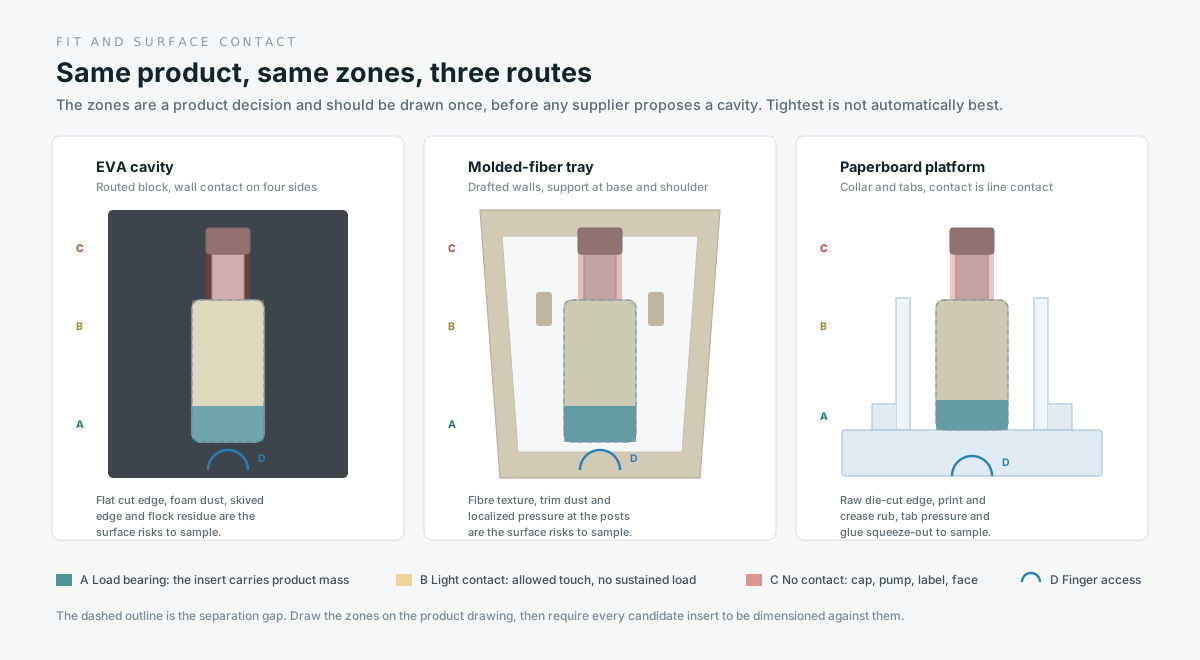
A cavity must fit the production range, not one convenient prototype. Record maximum and minimum product conditions, filled weight, protrusions, labels, decorative surfaces and the removal direction. Then define permitted contact, no-load zones and acceptable movement.
Tightest is not automatically best. Excessive contact can activate a pump, crush a label, polish a coating to a shine, or make removal unsafe enough that a customer drops the product on opening.
| Fit question | EVA route | Molded-fiber route | Paperboard route | | :--- | :--- | :--- | :--- | | How is the product located | Cavity walls, layers, reliefs and top restraint | Formed pockets, ribs, posts and tray walls | Collars, apertures, platforms, partitions and tabs | | Where can variation appear | Material thickness, compression, cutting, lamination and cavity process | Shrinkage, wall distribution, tooling, trim, moisture and process type | Board caliper, grain, crease, fold, die-cut registration, glue and assembly | | What may mark the product | Cut edge, lining, residue, odor, adhesive or pressure | Fiber texture, dust, edge, treatment or localized pressure | Raw edge, print, coating, fold, tab, adhesive or panel rub | | What must be sampled | Actual grade, thickness, lining and production cavity | Tool-representative process, surface and treatment | Production board, print, folds, glue and assembled geometry | | What must be inspected | Cavity dimensions, surface, adhesion, orientation and product fit | Critical dimensions, trim, wall, surface, nesting and fit | Cut, crease, fold, tab, glue, print, panel shape and fit |
Two habits prevent most fit failures. First, measure the production condition, not the golden unit — filled, capped, labeled, with the pump in its locked position. Our product measurement guide sets out how to record dimensions, range and accessories before the insert structure is developed. Second, record the removal direction on the drawing. A cavity that seats perfectly but cannot be lifted without tilting 40 degrees against a tight wall will fail in the customer's hands, not in the lab.
For glass and other breakable products, the same logic applies with a different failure mode. The fragile-product insert guide covers the support architecture and no-load zones specific to bottles and decanters.
5. Compare protection through matched package evidence
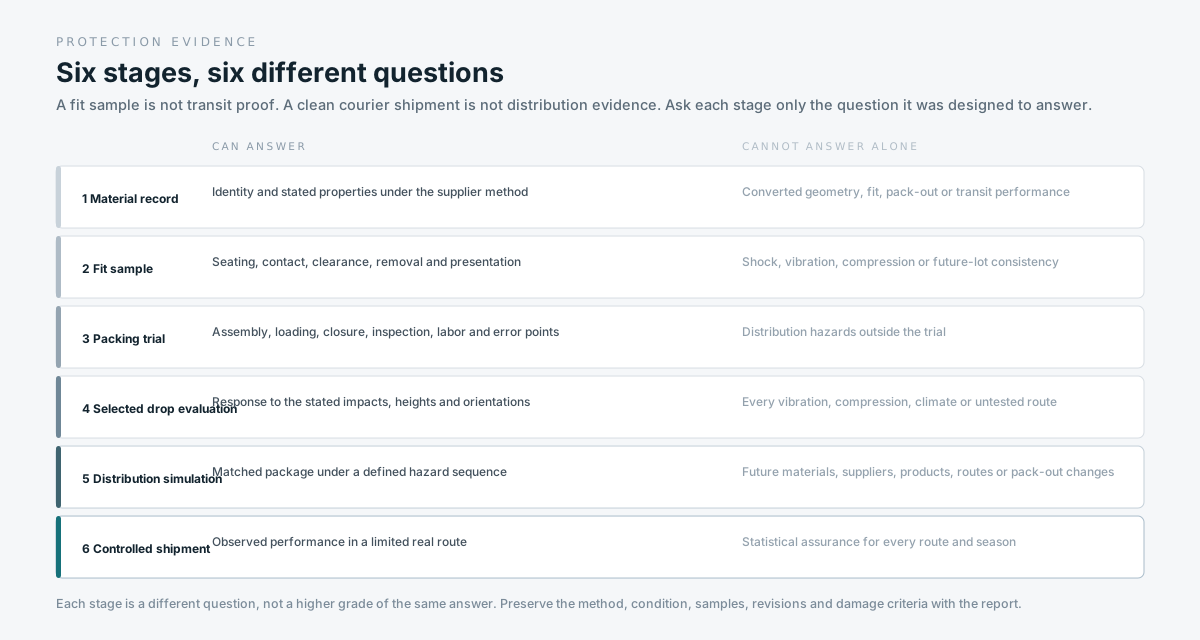
A material data sheet does not prove the finished insert, and a desktop fit check does not prove distribution performance. Protection comes from the complete packed system: product, insert, retail box, closure, overbox or master carton, pack-out and route. Compare candidates with the same product revision, the same outer dimensions where practical, the same failure criteria and the same test owner.
| Evidence stage | Can answer | Cannot answer alone | | :--- | :--- | :--- | | Material record | Identity and stated properties under the supplier method | Converted geometry, fit, pack-out or transit performance | | Fit sample | Seating, contact, clearance, removal and presentation | Shock, vibration, compression or future-lot consistency | | Packing trial | Assembly, loading, closure, inspection, labor and error points | Distribution hazards outside the trial | | Selected drop evaluation | Response to the stated impacts, heights and orientations | Every vibration, compression, climate or untested route | | Distribution simulation | Matched package under a defined hazard sequence | Future materials, suppliers, products, routes or pack-out changes | | Controlled shipment | Observed performance in a limited real route | Statistical assurance for every route and season |
ASTM D5276 provides a free-fall drop method for loaded containers, while ISTA procedures range from screening tests to general simulations for defined distribution situations. The qualified test owner should select the method, conditioning, samples, orientations, sequence and damage criteria. Preserve the complete report: a pass badge without its scope is not reusable evidence, and it cannot be transferred to a new cavity depth or a new board grade.
Two common errors sit inside this table. The first is treating a fit sample as protection evidence, which is how a 12 mm foam wall gets approved for a drop height it was never tested at. The second is treating one successful courier shipment as distribution evidence. Neither is dishonest; both are simply evidence being asked to answer a question it was never designed to answer.
6. Compare presentation and opening experience
Visible inserts carry brand and usability requirements as well as protection. EVA may be lined, laminated or colour-matched; molded fiber may range from rugged to smooth thermoformed surfaces; paperboard can carry high-quality print and finishing. Every added lining, coating, print layer or adhesive changes the construction, the surface risk, the cost and the recovery claim.
| Buyer decision | Record before approval | Review in the sample | | :--- | :--- | :--- | | Opening view | Product orientation, visible face, edge exposure and cavity depth | Brand view is stable and not hidden by structural features | | Surface quality | Color, texture, dust, odor, residue, print and finish expectation | Actual sample under agreed lighting and handling | | Removal | Finger access, lift direction, tabs, ribbons and cap handling | Unfamiliar user removes the product without damage or excessive force | | Repacking | Returns, service and component retention needs | Product and accessories can be restored when required | | Information | Labels, instructions, symbols and material-separation guidance | Required content remains visible and accurate |
Presentation is where the "premium" argument usually starts and where it most often goes wrong. A flocked EVA cavity photographed under a softbox looks luxurious; the same cavity in a customer's bathroom at 60% relative humidity can show dust along the cut edge. A thermoformed fiber tray looks clean and minimal until the first scuff from nesting appears on the outer wall. A rigid box with a paperboard platform can look just as considered, at a very different cost and recovery profile — which is why rigid box structures and their inserts are usually developed together rather than bought separately.
The practical test is a removal trial with someone who has never seen the pack. Time it, note where they grab, and check whether the product survives the first attempt. That single observation catches more design problems than any studio photograph.
7. Compare tooling, MOQ and total packed cost
Do not compare one insert unit price against another unless the quotation scope is normalised. A paperboard route may require a cutting die and more folding labor. A molded-fiber route may require forming and transfer or heated tooling. An EVA route may use CNC routing, waterjet, laser or cutting dies depending on geometry and volume. The actual route, tooling ownership, sample method and replacement rules must come from the supplier quotation, not from a general article.
| Cost field | Supplier must return | Why unit price is insufficient | | :--- | :--- | :--- | | Tooling | Tool type, ownership, maintenance, revision, replacement and storage terms | Different tools support different geometry, scale and change cost | | Sample | Material, process, quantity, appearance and performance limits | A low-cost sample may not represent production | | MOQ | Quantity by SKU, design, color, grade and shipment | A total quantity may split into several material minimums | | Insert price | Exact construction, packing state, quantity and Incoterm | Material names can hide thickness, layers, assembly and packaging | | Labor | Assembly, loading, inspection, rework and removal steps | Flat or multi-part structures can shift work to the buyer | | Logistics | Nested or flat volume, master-carton count, product-box size and freight basis | A lower unit price can consume more storage or shipping volume | | Quality loss | Inspection criteria, nonconformance handling and validated damage assumptions | Unverified damage or rework can dominate the material saving | | Change | New-tool, resample and reapproval triggers | A multi-SKU launch or reorder can reset the cost |
Total packed cost compares insert, tooling allocation, assembly labor, scrap, storage, outer-box impact, freight volume, inspection, expected rework and validated damage cost on the same quantity and route. If a field is unknown, keep it visible as an assumption rather than replacing it with a guess. A quote that is 40% cheaper per insert but doubles the master-carton volume and adds two assembly steps is not cheaper; it has moved money from the insert line to the freight and labor lines.
MOQ deserves a specific warning. "MOQ 500" is not a specification. 500 per colour? Per SKU? Per material grade? Per tool? Per shipment? A three-SKU programme quoted at 500 total can turn into 1,500 pieces of commitment once each SKU carries its own grade and colour. Ask for the MOQ per variable, then confirm what the real order would be.
8. Validate pack-out, storage and logistics
Insert materials arrive and move through operations differently. Paperboard can often ship flat but may require erection and locking. Molded-fiber trays may nest but can jam, dust or deform if the design and handling are poor. EVA may arrive as finished cavities or multi-part assemblies and can occupy significant volume. Observe the real receiving, storage, assembly, loading, closure and case-packing process rather than the brochure.
| Operation | Measure | Decision use | | :--- | :--- | :--- | | Inbound state | Flat, nested, layered, preassembled, wrapped or boxed | Storage space, contamination and damage control | | Denesting or erection | Time, tools, springback, jams, torn tabs and wrong orientation | Labor and line feasibility | | Product loading | Sequence, force, visibility, finger clearance and mispack points | Repeatability and training | | Closure | Lid pressure, bulge, cavity escape and component interference | Outer-box and insert compatibility | | Inspection | Visual, tactile, weight or scan checks | Detection of missing or incorrect components | | Case packing | Retail-box size, count, orientation, separators and pallet effect | Freight, storage and distribution efficiency | | Customer removal | Time, force, product drops, torn insert and repack behavior | Opening experience and returns |
This is where the material decision most often reverses. A nested fiber tray that saves 30 seconds of insertion can add 5 seconds of denesting per unit and a jam every 200 pieces. A flat paperboard platform that ships at 8% of its assembled volume can still cost more per unit in folding labor at low automation. EVA that arrives as a finished cavity is fast on the line but occupies warehouse volume all year.
Record the pack-out on video and count the steps. The written process will almost always be shorter than what actually happens at the bench.
9. Treat recycling and sustainability as evidence questions
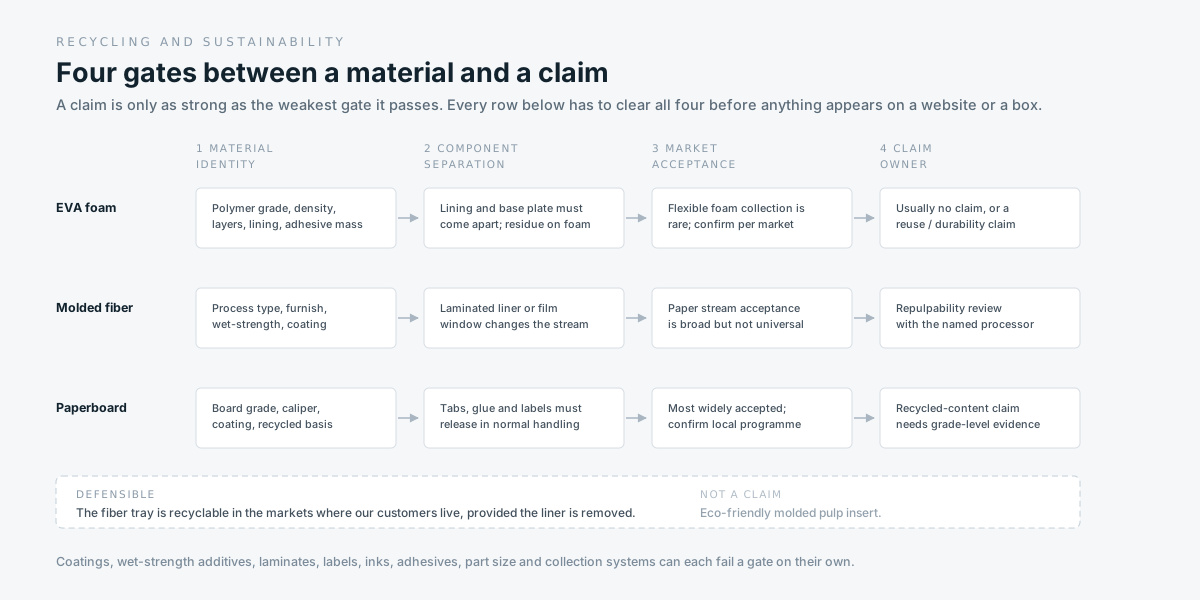
A paper-based appearance does not automatically prove recyclability, and a plastic foam label does not describe the actual local recovery route. Coatings, wet-strength additives, laminates, labels, inks, adhesives, mixed materials, contamination, part size and collection systems can each change the outcome. Define the target market and the claim owner before selecting the evidence.
| Claim question | Evidence needed | Do not substitute | | :--- | :--- | :--- | | What is the material | Supplier grade, fiber or polymer identity, additives, layers and mass | A trade name or visual guess | | Can components separate | Disassembly steps, residue and the state in which each component enters recovery | A removable-in-theory statement | | Is it accepted | Current collection or processor acceptance in the target market | Acceptance in another country or for another foam | | Is paper repulpable | Relevant coating, adhesive and treatment review or test where required | Paper content alone | | Is recycled content claimed | Supplier declaration, chain of custody or applicable verification for the exact grade | A generic industry average | | Is compostability claimed | Applicable certification, conditions, market labeling and exact finished construction | Biobased or paper-based wording | | Is impact lower | Defined boundary and comparable life-cycle or material assessment | A single material attribute |
AF&PA design guidance notes that non-fiber elements can affect paper-package recyclability, and the U.S. EPA tells users to confirm what their local programme accepts. ISO 18604 sets requirements and assessment procedures for packaging classified as recoverable through material recycling. Use these sources to frame the evidence request, not to certify a specific construction.
The honest position for most projects is narrower than the marketing position. "The fiber tray is recyclable in the markets where our customers live, provided the liner is removed" is a claim you can defend. "Eco-friendly molded pulp insert" is not a claim at all: it is a mood.
10. Plan multi-SKU programmes and reorders
A material that works for one SKU may not be the best programme platform. Review which dimensions, surface requirements and hazards are genuinely shared. A common outer box with changeable inserts can simplify branding, but each cavity still needs approval. Product, material, supplier, geometry, adhesive, surface treatment, pack-out, outer box and route changes may each require impact review, resampling or retesting.
| Programme question | Control to document | Reapproval trigger | | :--- | :--- | :--- | | Can one insert fit several SKUs | Approved dimensional envelope, weight, center of gravity and no-load zones | A new SKU falls outside the envelope | | Can one box use several inserts | Insert outer dimensions, capture, lid clearance and case count | Insert changes box closure or route performance | | Can material change at reorder | Exact grade, supplier, thickness or density, fiber process and treatment | Any unapproved substitution | | Can tooling move suppliers | Tool ownership, files, maintenance, process and transfer qualification | New machine, location or conversion route | | Can sustainability claims continue | Current supplier evidence and target-market acceptance | Claim scope, material or market changes |
Substitution at reorder is the quietest failure in this whole comparison. A supplier runs short of the 45 kg per cubic metre foam and ships 38 kg in the same colour, or switches from virgin kraft to a recycled furnish in the same caliper. The insert looks identical, weighs less, and the drop performance changes. Write the substitution rule into the purchase order: no material, supplier, tool, geometry, treatment, adhesive, process or site change without written review.
11. Build a project-weighted decision matrix
A scorecard is useful only when the buyer defines the weights and the evidence threshold. Do not copy a supplier's universal ranking. Set the critical criteria first, decide which are pass or fail, assign project weights to the remaining criteria, and score only against evidence from the matched construction.
| Criterion | Project input | Evidence to score | Example decision rule | | :--- | :--- | :--- | :--- | | Product protection | Failure criteria and route | Matched package test and damage inspection | Pass or fail before weighted scoring | | Fit and surface | Product range and contact limits | Production-representative sample review | No prohibited contact or unacceptable mark | | Presentation | Opening view and finish expectation | Approved physical sample | Score only after brand review | | Pack-out | Labor, error and throughput target | Observed packing trial | Use measured steps and time | | Commercial | Quantity, tooling horizon and forecast | Normalised quotation | Compare same scope and quantity | | Logistics | Storage, box size and route | Pack dimensions, nesting and case count | Use landed packed-system effect | | Recovery | Target market and claim | Material and acceptance evidence | No claim without defined route | | Change risk | SKU and reorder plan | Tooling and reapproval rules | Penalise unbounded substitution |
Two rules make the matrix behave. First, protection and fit are gates, not scores: a candidate that fails the drop criteria does not get to win on price, however favourable the arithmetic. Second, weights belong to the project, not to the supplier and not to this article. A gift-set launch in a humid market and a replacement-component programme share almost no weights.
12. Ask every supplier to return the same specification
The fastest way to compare three materials is to stop asking three different questions. Issue one brief, require one return format, and refuse to evaluate a proposal that leaves fields blank.
| Return field | Supplier must state | | :--- | :--- | | Project basis | Product IDs, revision, production dimensions or range, packed weight, orientation and accessories | | Package role | Presentation, retail, parcel, overbox, master-carton or mixed-channel system | | Material identity | EVA grade and density, molded-fiber type and furnish, or paperboard grade and caliper, plus supplier IDs | | Complete construction | Layers, wall or board geometry, cavity, folds, tabs, lining, coating, adhesive, color and surface | | Contact map | Load-bearing, retention, light-contact, no-contact, finish, finger-access and separation zones | | Tooling | Tool type, ownership, life basis, revision, storage, maintenance, replacement and change terms | | Samples | Concept, structural, material, decorated, production-equivalent and packed-validation scope | | Commercial | MOQ by SKU or grade, unit-price basis, tooling, sample, assembly, packing and change charges | | Operations | Inbound state, assembly, loading sequence, inspection, storage and case-packing assumptions | | Validation | Method, condition, samples, sequence, product and package revisions, criteria and report reference | | Recovery claims | Exact claim, material basis, separation, issuing body or market evidence, date and scope | | Change control | No material, supplier, tool, geometry, treatment, adhesive, process or site substitution without written review |
Comparable RFQ brief
| Brief field | Minimum information | | :--- | :--- | | Product | SKU and revision, finished dimensions or range, packed weight, center of gravity, fragile and surface zones | | Set contents | Caps, pumps, accessories, manuals, cables, liquids and quantity per package | | Insert job | Restraint, support, cushioning, separation, surface, presentation and packing requirements | | Packaging system | Outer box, closure, overbox, master carton, case count and delivery state | | Operations | Manual or automated packing, loading sequence, throughput, inspection, returns and repacking | | Route | Retail, parcel, fulfillment, LTL, export, pallet, climate, storage and destination | | Commercial | Quantity by SKU, forecast, tooling horizon, target date, Incoterm and budget context | | Sustainability | Target market, restricted materials, required claim, separability and evidence owner | | Approval | Sample stages, tests, reports, approvers and reapproval triggers |
Copyable RFQ instruction: Please propose comparable EVA foam, molded-fiber and paperboard insert constructions where technically feasible for the attached product and package brief. Return the exact material identity, complete geometry, contact map, tooling route, sample plan, MOQ and price basis, pack-out, outer-package assumptions, validation evidence, target-market recovery claim and change-control rule. Identify any option that cannot meet a pass requirement and explain why. Do not replace these fields with a generic material recommendation.
Our structural design and sampling process follows the same stage logic, so a sample received from us can be matched against the stage it was meant to prove.
Frequently asked questions
Is EVA foam always more protective than molded pulp? No. Protection depends on the exact grade, density, thickness, cavity geometry, outer box, product and route. A 12 mm EVA cavity can underperform a well-designed fiber tray with proper draft and a rigid outer box, and both can fail a drop that a paperboard platform survives because the platform keeps the product centred away from the box walls. Compare production-representative packages under the same failure criteria.
Is molded pulp always recyclable? No universal claim applies. Confirm the fiber process, additives, coatings, labels, contamination, component separation and current acceptance in the target market. A wet-strength or laminated fiber tray sits in the same recycling stream as an uncoated one, but its repulpability is a different question that needs its own evidence.
Can paperboard inserts protect fragile products? Sometimes, within a matched package. Folded platforms, collars, dividers and corrugated combinations can restrain and support, but the complete pack must be validated for the product and the route. Paperboard rarely provides cushioning on its own; it provides structure, separation and positioning.
Which insert looks most premium? Premium appearance is a project decision, not a material property. EVA may use lining or colour, molded fiber can range from rugged to smooth thermoformed surfaces, and paperboard can carry high-quality print and finishing. Judge the approved physical sample under the lighting and handling your customer will actually experience.
Which insert has the lowest tooling cost? It depends on geometry, sample route, production process, quantity and supplier. A simple paperboard die can be inexpensive but limited in geometry; a foam cutting path may need no tool at low volume but becomes a die cost at scale; fiber forming tooling is usually the largest of the three. Require the exact tool type, ownership and revision terms in every quotation rather than a headline figure.
Which material has the lowest MOQ? MOQ is project-specific and varies by grade, colour, process, tool, SKU and packing. Compare written supplier terms rather than a website number, and ask for the MOQ per variable so a multi-SKU order does not multiply unexpectedly.
Can one insert serve multiple SKUs? Only within an approved product envelope and package role. Confirm fit, support, no-load zones, removal and route evidence for every included SKU, and write the envelope into the specification so a future variant cannot slip in unapproved.
What should a sample prove? State the sample stage. A concept can show arrangement, a structural sample can show fit, and a production-equivalent pack can support operational and route validation when genuinely matched. A sample without a declared stage proves nothing in particular.
What change requires reapproval? Changes to the product, material grade, supplier, density or caliper, geometry, tooling, lining, treatment, adhesive, outer box, pack-out, route or production site may require review, resampling or retesting. Treat any unapproved substitution as a new project.
Send the Insert Comparison Brief
Send the actual product or representative units, dimensions and range, packed weight, sensitive surfaces, package role, box style, quantity by SKU, packing method, destination and sustainability requirements. ChromaPack can use that brief to compare practical EVA, molded-fiber and paperboard constructions, identify missing evidence and define the material, structural, operational, route and recovery checks required before approval.
Request an insert material comparison — include a photo of the current pack if one already exists.
Authoritative Sources
- IMFA Education Hub — Industry association design and manufacturing resources for thick-wall, transfer-molded and thermoformed molded fiber.
- IMFA About Molded Fiber — Association overview of the four basic molded-fiber types and their process differences.
- Paperboard Packaging Council — Industry overview of paperboard grades, folding cartons and mini-flute structures.
- AF&PA Design Guidance for Recyclability — Guidance on how non-fiber elements can affect paper-based packaging recyclability.
- US EPA — Public guidance on confirming local acceptance for paper and plastic materials.
- ISO 18601 — Framework for applying the ISO packaging-and-environment standards.
- ISO 18604 — Requirements and assessment procedures for packaging recoverable through material recycling.
- ASTM D5276 — Free-fall drop test method for loaded containers and inner packing.
- ISTA — Screening and general simulation procedures for defined distribution situations, plus retesting guidance.