
Structural Design
November 2026 | 19 min read | By ChromaPack Engineering Content
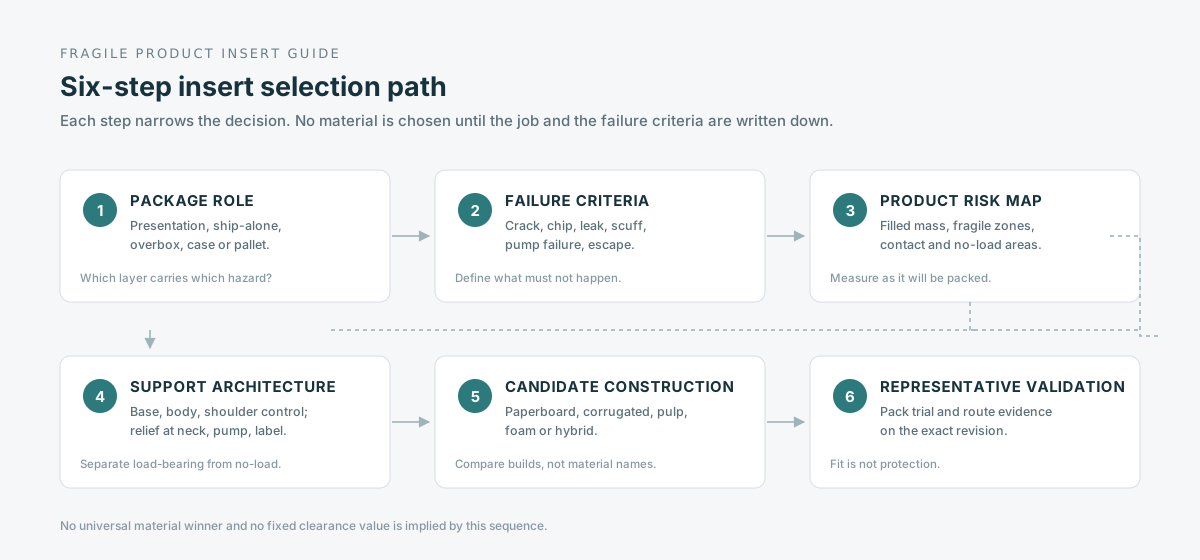
Short answer: Choose packaging inserts for fragile products by defining the complete packed system before selecting paperboard, corrugated board, molded pulp or foam. Record the real product, filled weight, dimensional range, fragile features, allowed contact, no-load zones, desired movement, removal direction, retail or shipping role and failure criteria. Then develop the insert and outer package together and validate the exact production-representative pack against the intended packing and distribution route. A material name or snug desktop fit cannot prove protection.
Decision rule: Start with what must not happen. Decide where the product may be supported, where it must not be loaded, how the insert will be packed and removed, and which packaging layer carries each hazard. Approve the construction through matched physical samples and route-relevant evidence.
1. Define the job before choosing the insert material
An insert can hold position, carry load, absorb or spread impact, separate products, protect a surface, control orientation, improve presentation and guide packing. Those jobs are related but not identical. A folded platform may present a bottle beautifully while transferring an impact into its base. A soft cavity may reduce movement yet press a pump or mark a coated surface. Write the required jobs and the failure signals before asking which material is best.
| Insert job | What it controls | Failure signal | Buyer must define | | :--- | :--- | :--- | :--- | | Restraint | Limit translation rotation lift or rattle | Movement after handling, escaped cavity, closure interference | Allowed movement and retention method | | Support | Carry static product load at suitable areas | Sagging, panel bow, concentrated pressure, insert collapse | Support locations and load path | | Cushioning | Manage shock input through deformation or geometry | Crack, chip, leak, pump failure or excessive acceleration | Hazard profile and verified construction | | Separation | Prevent product-to-product or product-to-wall contact | Glass collision, scuffing, accessory impact | Minimum separation after packing and test | | Surface protection | Avoid rub, residue or pressure on sensitive finishes | Label wear, lacquer mark, scratch, coating transfer | Permitted contact materials and zones | | Presentation | Control orientation visibility and removal | Tilted product, hidden branding, awkward extraction | Opening view and customer removal path | | Packing control | Make the correct pack repeatable | Wrong orientation, missed component, slow assembly | Work sequence, poka-yoke and inspection point |
2. Build a production-condition product risk map
Measure the finished product as it will be packed, not an empty bottle body, ideal CAD shell or convenient prototype. Filled mass changes the load path. A cap, pump, applicator, cable or manual changes the envelope. Production variation changes the cavity fit. Use representative units and identify both the largest fit condition and the condition most likely to move.
| Data group | Record | Do not substitute | | :--- | :--- | :--- | | Geometry | Maximum dimensions, dimensional range, shape, protrusions and orientation | One nominal L x W x H | | Mass | Filled or operating weight, center of gravity and concentrated loads | Empty container weight | | Fragile features | Thin edges, glass base, shoulder, neck, pump, cap, screen, connector or ceramic rim | Fragile as one general label | | Contact zones | Areas that may carry load, may touch lightly or must remain untouched | Tight everywhere | | Surface | Label, print, lacquer, frosting, metal finish, display or polished face | Assume all surfaces tolerate rub | | Contents | Liquid, powder, accessory, battery, cable, manual and leak consequence | Primary product only | | Use | Retail display, gift set, parcel, overbox, case pack, returns and repeated opening | One undefined shipping scenario |
Use the product measurement guide to collect the finished dimensions, orientation and accessories before insert development.
3. Design contact support and clearance deliberately
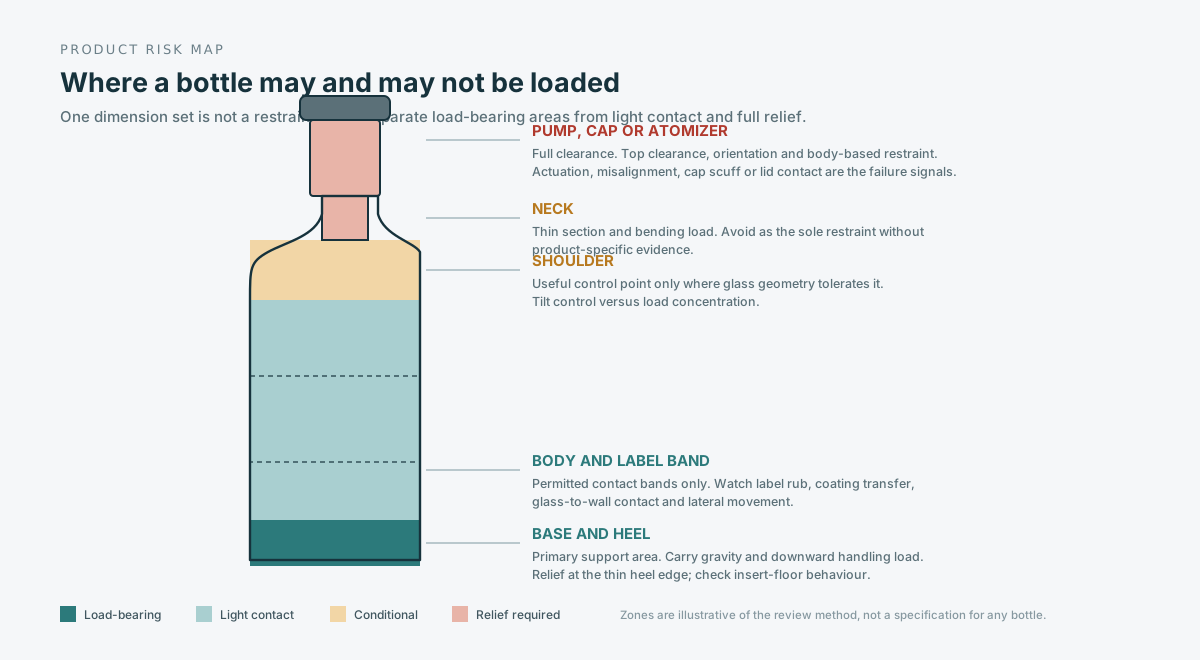
The insert should route loads through areas the product can tolerate. That does not always mean maximum contact. A bottle can be supported at the base and body while leaving its pump, cap decoration or label free. A device can be held at structural edges while keeping pressure away from a display or control. The outer box, insert and product form one load path; review them together.
| Design feature | Job | Risk to avoid | Approval input | | :--- | :--- | :--- | :--- | | Base support | Carry gravity and downward handling loads | Thin glass heel, unstable foot, insert floor collapse | Representative filled product and bottom clearance | | Lateral restraint | Limit side movement and rotation | Label rub, wall strike, cavity escape | Body contact zones, product tolerance and allowed movement | | Upper control | Prevent lift, tilt or cap-to-lid contact | Pump actuation, cap scuff, neck load | Shoulder or body control with closure clearance | | Edge and corner relief | Keep brittle edges from concentrated contact | Chip, crack or cosmetic dent | Relief geometry and route-relevant test | | Finger access | Allow controlled customer or packer removal | Product pried by cap, torn insert, drop during removal | Removal direction and access point | | Tolerance strategy | Fit the production range without force or rattle | Largest unit binds, smallest unit moves | Measured range, sample set and acceptance criteria |
4. Compare complete insert constructions, not material names
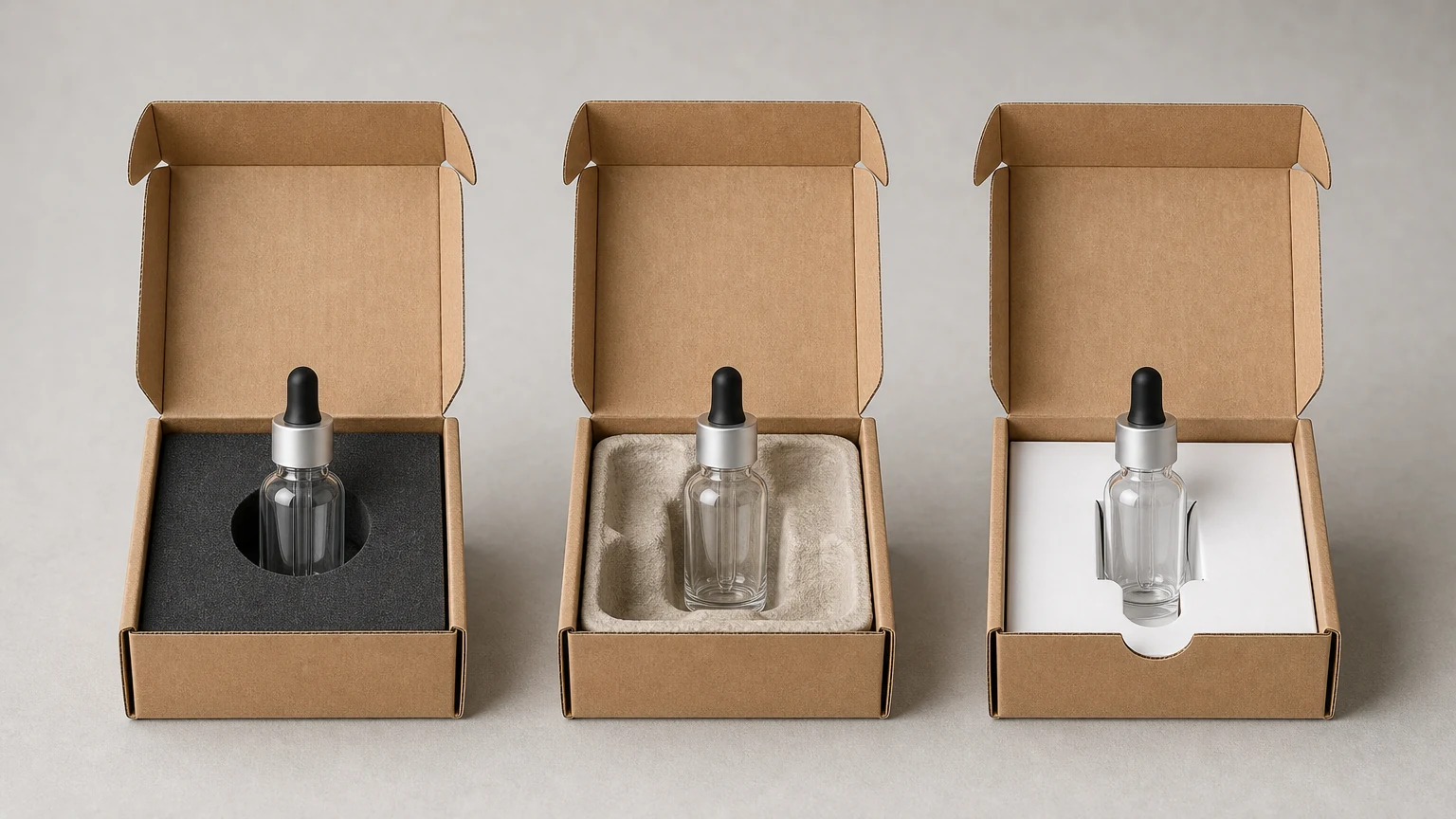
Material is one part of the construction. Thickness, density, fiber mix, flute, fold pattern, cavity depth, adhesive, lining, molded geometry and the outer box can change the result. Treat the options below as candidate directions. Ask the supplier to identify the full build and verify the converted insert with the real product.
| Candidate route | Useful starting role | Questions before approval | | :--- | :--- | :--- | | Folded paperboard | Printed platforms, collars, pockets and light-to-moderate restraint | Fold stiffness, tab retention, score behavior, moisture, edge contact and packer assembly | | Corrugated board | Partitions, cells, pads and deeper structural support | Flute direction, exposed edges, local crush, panel span, print route and outer-case relationship | | Molded fiber or pulp | Shaped cavities and multi-point support | Tooling, draft, dimensional variation, surface texture, dust, moisture and actual recovery claim | | EVA or other foam | Precisely cut or layered cavities and premium presentation | Foam type, density, compression behavior, odor, residue, color transfer, adhesive and disposal claim | | Thermoformed tray | Repeatable shaped pockets and component organization | Resin, gauge, static or surface needs, trim edge, nesting, recycling market and tooling | | Hybrid construction | Combine structural paper, selective cushioning, lining or top sheet | Assembly steps, adhesive, material separation, tolerance stack and total packed cost |
A paper-based route is not automatically lower impact, and a foam route is not automatically the safest. Compare the same product, box role, damage criteria, material mass, manufacturing yield, packing labor, extra shipping layers, damage outcome and destination recovery conditions. Publish environmental statements only when the exact construction and market evidence support them.
For a material-by-material breakdown of foam, blister and molded paper trays, see the custom packaging inserts comparison guide. Current construction options are listed on the packaging inserts page.
5. Protect the whole glass bottle assembly
A bottle is more than a glass cylinder. The base edge may be vulnerable to impact, the shoulder may offer a better control point than the neck, a pump or atomizer may fail without visible glass damage, and a decorative label or coating may scuff before the bottle breaks. Filled liquid also changes mass and leakage consequences. Review the complete primary pack and closure.
| Bottle zone | Failure concern | Design question | | :--- | :--- | :--- | | Base and heel | Chipping, concentrated impact, unstable seating | Support area, relief, bottom pad and insert-floor behavior | | Body | Lateral movement, label rub, glass-to-wall contact | Permitted contact bands and finish-compatible surface | | Shoulder | Tilt control or load concentration | Use only where geometry and glass design tolerate support | | Neck | Thin section, closure interface and bending load | Avoid using as the sole restraint without verified product evidence | | Pump cap or atomizer | Actuation, misalignment, scratch or lid contact | Top clearance, orientation and body-based restraint | | Liquid and closure | Leak, contamination and secondary package damage | Closure evidence, upright assumptions, absorbent or containment requirement where applicable | | Finish and label | Scuff, transfer, dent or print loss | Contact material, rub exposure and post-test appearance criteria |
6. Keep multiple products from becoming impact tools
In a set, one product can damage another. Heavy items can load a fragile bottle, hard accessories can strike glass, and a loose applicator can scratch a decorated surface. Define each cavity, separation wall and loading sequence. Do not rely on a divider that collapses, settles or allows products to meet after repeated handling.
| Set interaction | Failure path | Control to evaluate | | :--- | :--- | :--- | | Bottle to bottle | Direct collision or synchronized movement | Individual cavities, stable separation and post-test contact inspection | | Heavy to fragile | Mass transfers through divider or lid | Load path, vertical arrangement and independent support | | Accessory to finish | Cap, tool, cable or applicator scratches surface | Dedicated pocket, wrap or covered contact edge | | Different heights | Lid load reaches tallest or least supported item | Risers, stepped platforms, top clearance and box closure | | SKU variation | Wrong cavity, empty location or forced fit | Visual pack rule, common-platform limits and size-specific approval | | Returns | Customer cannot reproduce the protective arrangement | Simple orientation, clear seats and return-pack instructions where needed |
7. Define the retail box and shipping layers
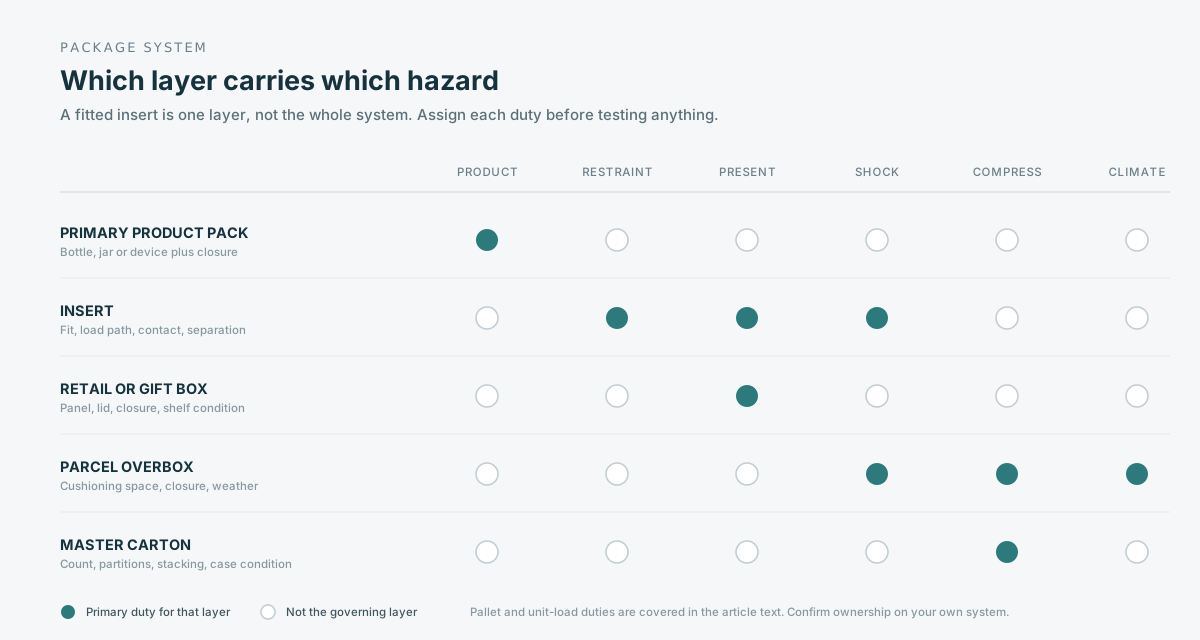
A premium insert inside a rigid box may be a presentation system, not a parcel shipper. A folding carton may require an outer case. A mailer may ship alone only when the exact product, insert, closure and route have been validated. State which layer carries impact, compression, abrasion, leakage, weather, labels, tamper evidence and consumer presentation.
| Packaging layer | Primary role | Evidence boundary | | :--- | :--- | :--- | | Primary product pack | Bottle, jar, device or component plus closure | Product integrity, leakage and finish | | Insert | Restraint, support, separation and presentation | Fit, load path, contact and packing repeatability | | Retail or gift box | Brand presentation and local structure | Panel, lid, closure, insert capture and shelf condition | | Parcel overbox | Individual distribution hazards and labels | Cushioning space, closure, compression, shock and weather exposure | | Master carton | Multiple retail packs through storage and transport | Count, orientation, partitions, stack and case condition | | Pallet or unit load | Grouped handling and long-haul distribution | Pattern, restraint, compression, climate and transfer points |
Carrier and retailer guides can inform the hazard brief, but they do not replace project validation. Official carrier guidance commonly emphasises separation, individual cushioning, containment for liquids and stronger outer packaging for fragile goods. The applicable construction still depends on the channel, service, destination and product. For premium fitted presentation formats, see luxury rigid boxes.
8. Validate the packing and opening operation
An insert that works for a designer can fail at the packing line. Observe a real packer erect, load, seat, close, inspect and case-pack the product. Then ask an unfamiliar user to open and remove it. Record time, force, orientation errors, missed components, torn tabs, trapped labels, product drops and whether the pack can be closed without pressing a fragile feature.
| Operation | What happens | Observe and record | | :--- | :--- | :--- | | Erection | Insert arrives flat, nested or preassembled | Assembly steps, tooling, springback and damage | | Loading | Product and accessories enter in a defined order | Force, orientation, finger clearance and mispack points | | Seating | Product reaches the intended support points | Visual or tactile confirmation and allowed movement | | Closure | Box closes without unintended product load | Lid clearance, compression, bulge and seal condition | | Inspection | Packer can detect missing or incorrect parts | Visible checks, weight check or scan where appropriate | | Removal | Customer can remove product safely | Finger access, lift point, cap handling and insert damage | | Repacking | Returns or service may require replacement | Repeatability, instructions and component retention |
9. Match the evidence to the question
A fit check answers whether the product seats. It does not prove shock protection. A material data sheet describes a material under stated conditions. It does not prove the converted insert or finished package. ISO 2248 and ASTM D5276 describe free-fall drop methods for complete loaded packages, while ISTA procedures combine hazards for defined distribution situations. A qualified owner should choose the method, samples, conditioning, orientations, sequence and damage criteria.
| Evidence | Can answer | Cannot answer alone | | :--- | :--- | :--- | | Product fit review | Cavity, contact, clearance, insertion and removal | Transit shock, compression, vibration or production consistency | | Material or component data | Specified material property under the stated method | Converted geometry, adhesive joint or finished package performance | | Packing trial | Assembly, loading, closure, inspection and throughput | Every distribution hazard outside the trial | | Package drop evaluation | Response to the selected impacts and orientations | Vibration, compression, climate, abrasion or untested routes | | Distribution simulation | Matched packaged product under a defined hazard sequence | Future product, material, process, channel or destination changes | | Controlled shipment | Observed performance in a limited real route | Statistical assurance for every route or season |
Define failure before testing. For fragile products, acceptance may include no crack, chip, leak, pump malfunction, label damage, unacceptable scuff, product escape, insert collapse or box condition beyond the agreed boundary. Record the product and package revision, sample count, conditioning, equipment, orientations, sequence, observations and every failure. A pass badge without those fields is not reusable engineering evidence.
10. Approve the design through a matched sample ladder
| Evidence stage | Can support | Does not automatically prove | | :--- | :--- | :--- | | Product and risk brief | Production-condition data, failure criteria and package role | Any insert construction or performance | | Concept or digital model | Arrangement, support intent, access and approximate box relationship | Material behavior, real tolerances, packing or route performance | | Structural prototype | Fit, support, clearance, loading and removal with representative products | Final material, process, production consistency or shipping result | | Material and finish sample | Touch, surface contact, color, lining and basic conversion behavior | Exact final geometry or full package performance unless matched | | Production-equivalent pack | Specified product, insert, box, closure, assembly and process when genuinely matched | Future lots, routes, product variants or untested hazards | | Packing and route validation | The exact assembly under selected operational and distribution conditions | Unapproved changes or all future destinations |
Retain product and package revisions, material identifiers, sample IDs, pack-out, test setup, observations, deviations, approvers and reapproval triggers. ISTA advises retesting when the product, package or process changes and performance may be affected. Use a written impact review for changes to product weight, dimensions, closure, insert material, supplier, geometry, adhesive, box, pack-out, channel or production location.
The sampling and approval workflow guide covers how each of these stages is requested, reviewed and signed off before production.
11. Ask the supplier to return a complete insert specification
A quote that says "EVA insert", "paper insert" or "molded-pulp tray" is not comparable. Require the same return fields from each supplier and preserve them through prototypes, production and reorders.
| Return field | Supplier must state | | :--- | :--- | | Product basis | Product IDs, revision, production dimensions or range, filled weight, orientation and accessories | | Package role | Presentation box, retail carton, ship-alone parcel, overbox, master carton or mixed-channel system | | Insert construction | Format, material supplier code or grade, thickness or density where relevant, layers, lining, adhesive and color | | Support map | Load-bearing, retention, clearance, no-contact, finger-access and separation zones | | Geometry | Dieline or CAD revision, cavity dimensions, tolerances, draft, flute direction, folds, tabs, glue and nesting | | Outer package | Internal dimensions, material, closure, orientation, overbox, case pack and shipping assumptions | | Compliance scope | Food-contact, restricted substances, recycled content, static control or market claims with issuing body, date and exact material | | Samples | Concept, structural, material, decorated, production-equivalent and packed validation scope | | Tests | Method, condition, sample count, orientation, sequence, product revision, pass criteria and report reference | | Inspection | Measurement locations, visual and functional criteria, sampling, retention and nonconformance process | | Change control | No material, supplier, geometry, adhesive, process, product, pack-out or site substitution without written disclosure and agreed review |
Do not compare a presentation insert, a ship-alone package and a master-carton system as though the insert alone provides the same protection. Normalise the product, package role, outer layers, packing operation, test method and acceptance criteria before comparing anything.
12. Send a comparable fragile product brief with the RFQ
| Brief field | Minimum information | | :--- | :--- | | Product | SKU and revision, finished dimensions or range, filled weight, center of gravity, fragile features and finish zones | | Contents | Caps, pumps, closures, liquids, accessories, manuals, cables and quantity per package | | Presentation | Orientation, visible face, opening sequence, removal point and brand requirements | | Protection | Known damage history, prohibited contact, allowed movement, leakage consequence and failure criteria | | Packaging system | Retail or gift box, insert, closure, parcel overbox, master carton, case count and delivery state | | Operations | Manual or automated packing, loading sequence, throughput, inspection, returns and repacking | | Channel | Retail, parcel, ecommerce fulfillment, LTL, export, pallet, destination, climate and storage assumptions | | Evidence | Required sample stages, pack trial, test owner, methods, reports, approvers and reapproval triggers | | Commercial | Quantity by SKU, forecast, tooling, target date, material restrictions, destination and budget context |
Copyable RFQ instruction: Please recommend a packaging insert construction for the attached production-condition product data and package route. Return the product basis, package role, complete insert material and geometry, support and no-contact zones, cavity tolerances, outer-box assumptions, packing sequence, sample ladder, validation method and change-control rule. Explain any deviation. Do not replace these fields with a generic material recommendation or fixed product weight limit.
Frequently Asked Questions
What is the best packaging insert for a glass bottle? There is no universal material winner. Define the filled bottle, fragile zones, finish, package role, outer layers, packing operation and route. Compare complete paperboard, corrugated, molded-fiber, foam or hybrid constructions with matched samples and evidence.
Should a fragile product fit tightly in the insert? It should be controlled without loading prohibited zones or creating unacceptable rub, force or removal difficulty. Specify allowed movement and contact rather than asking for the tightest possible cavity.
Where should a glass bottle be supported? Support depends on the bottle design. Common review points include the base, body and shoulder, while necks, pumps, caps, labels and decorated surfaces may need relief. Confirm the actual product with the structural owner.
Can a paperboard insert protect a glass bottle? Sometimes, within a matched box and route. Folded paperboard can restrain and support, but its performance depends on board, folds, spans, contact, outer packaging and hazards. Validate the complete pack rather than the material name.
Is EVA foam always better for fragile products? No. Foam type, density, thickness, cavity, compression, surface compatibility, adhesive, odor and the outer package matter. It can be a useful candidate, but the converted construction needs project evidence.
Do multiple bottles need separate cavities? They need a verified way to prevent damaging contact and unstable load transfer. Separate cavities, molded supports or other systems may work when the exact pack-out remains separated after handling and testing.
Can a rigid gift box ship without an outer carton? Only when the exact product, insert, box, closure and distribution route are suitable and validated. Many premium boxes still need an overbox to protect the product and presentation surfaces.
What should a drop test prove? A selected drop evaluation can show response to stated impacts and orientations. It does not answer every vibration, compression, climate, route or future-change question. Preserve the method, condition, samples and damage criteria.
What insert change requires reapproval? Changes to the product, weight, dimensions, closure, insert material, supplier, geometry, adhesive, lining, outer box, pack-out, process, channel or production site may require impact review, resampling or retesting.
Send the Fragile Product Insert Brief
Send the actual product or representative units, finished dimensions and range, filled weight, caps or pumps, sensitive surfaces, accessories, package role, box style, quantity by SKU, packing method, destination and whether the presentation box must ship alone. ChromaPack can use that brief to compare practical insert constructions, identify missing evidence and define the structural, material, packing and route checks required before approval.
Request a fragile-product insert review — include photos of the packed product if the pack-out already exists.
Authoritative Sources
- ISO 2248:1985 — Complete filled transport packages, vertical impact by dropping.
- ASTM D5276-19(2023) — Drop test of loaded containers by free fall.
- ISTA — Test procedures for defined distribution types, plus guidance to retest when product, package or process changes may affect performance.
- UPS — Packaging guidance on cushioning, bottle containment and double-boxing for fragile goods.
- FedEx — Packaging guidance on separation, individual cushioning, centring and double-boxing for breakables.