
Material Science
October 2026 | 14 min read | By ChromaPack Engineering Content
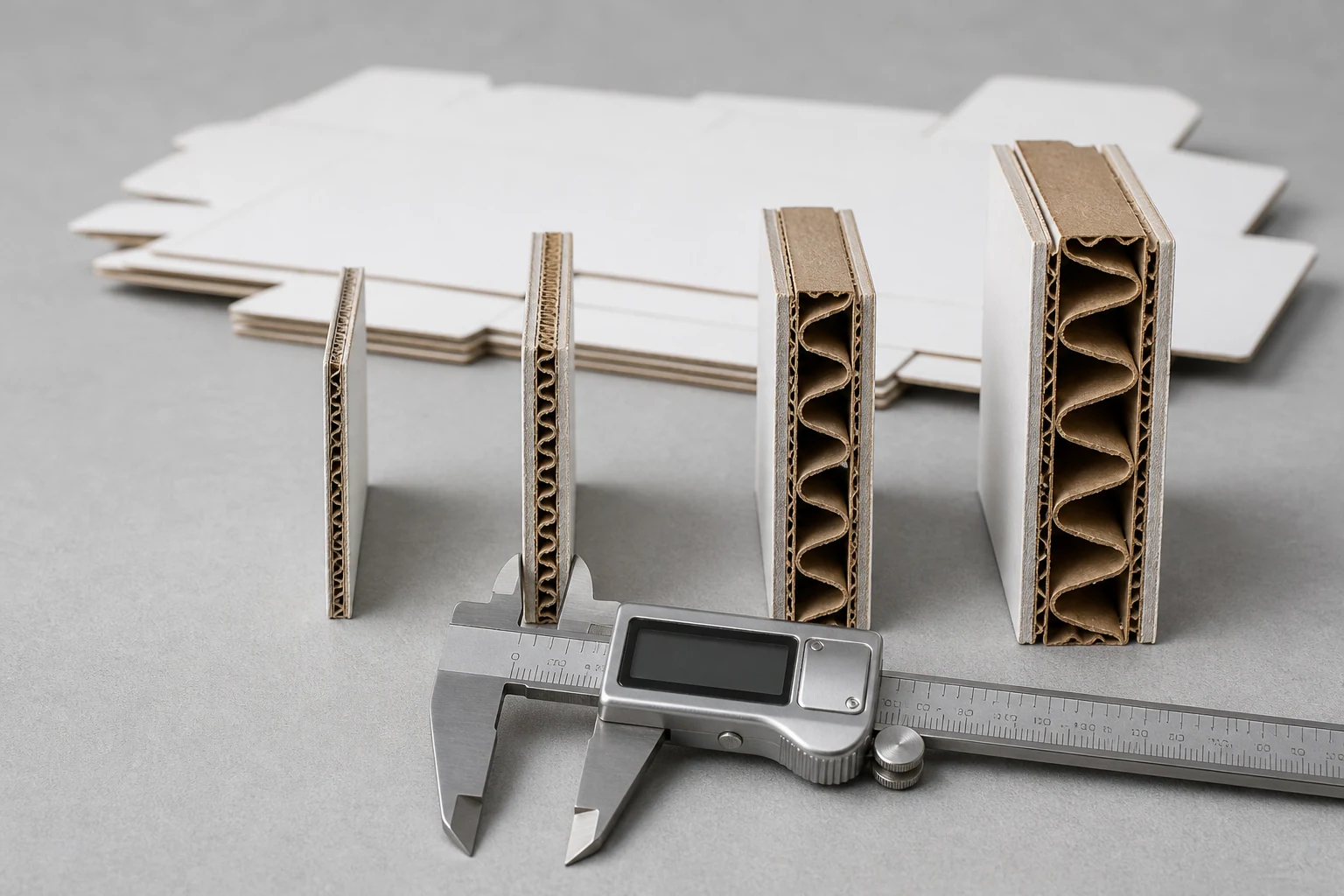
Short answer: Choosing the correct corrugated flute for a custom mailer box comes down to a direct engineering compromise between print surface smoothness, cushioning deflection, and dimensional freight volume.
- E-Flute (1.2–1.8 mm / 1/16"): The global standard for D2C e-commerce, subscription boxes, and cosmetics weighing under 2.5 kg (5.5 lbs). It provides an ultra-flat surface eliminating 'washboarding' under direct printing while minimizing dimensional shipping weight.
- B-Flute (2.5–3.2 mm / 1/8"): Offers 40–50% higher crush and puncture resistance, making it ideal for heavier goods (2.5–8.0 kg), fragile glassware, ceramics, and master shipping cartons.
- F-Flute (0.8–1.0 mm / 1/32"): Bridges the gap between folding carton aesthetics and corrugated crush resistance, tailored for luxury beauty, jewelry, and high-end tech accessories.
- C-Flute (3.6–4.5 mm / 5/32"): Engineered for heavy secondary master cartons, not retail-ready roll-end tuck-front (RETF) mailer boxes.
If your decision is still at the level of box family rather than board grade, start with folding carton vs rigid box vs corrugated mailer.
1. Anatomy of Corrugated Board: Pitch, Caliper, and Flute Take-up
A corrugated mailer box is rarely a single homogeneous sheet of paperboard. It is an engineered composite structural sandwich comprising three distinct bonded elements:
- Outside Linerboard: The primary printable exterior facing (typically 175–250 gsm white top kraft, bleached SBS, or natural unbleached kraft).
- Fluting Medium: The wave-formed corrugated paper arched into continuous structural arches (typically 105–140 gsm semi-chemical or recycled medium).
- Inside Linerboard: The interior-facing substrate supporting structural tension and interior unboxing prints (typically 140–200 gsm kraft or white liner).
The physical geometry of the corrugating medium governs the mechanical behavior of the assembled box:
- Flute Caliper (Thickness): The vertical distance between outer and inner liners. Higher calipers provide greater deflection distance, directly correlating with impact cushioning and shock dampening.
- Flute Pitch (Frequency): The count of individual flute crests per linear meter. Higher frequency means support arches are clustered tightly together, creating an exceptionally flat canvas for printing.
- Take-Up Factor: The ratio of flat medium paper length required to produce one linear meter of corrugated board (ranging from 1.25 for F-Flute to 1.45 for C-Flute).
2. Flute Profiles Compared: Technical Specifications Matrix
The following engineering specifications compare single-wall (3-ply) corrugated boards commonly manufactured in ChromaPack's precision corrugator facilities:
| Flute Grade | Nominal Thickness | Flutes per Meter | Surface Smoothness | Shock Absorption | Max Product Weight | Primary Packaging Style | | :--- | :--- | :--- | :--- | :--- | :--- | :--- | | F-Flute | 0.8 – 1.0 mm (1/32") | 410 – 430 | Superior (near folding carton) | Low (<0.6 mm deflection) | Up to 1.0 kg (2.2 lbs) | Luxury retail, skincare, jewelry boxes | | E-Flute | 1.2 – 1.8 mm (1/16") | 290 – 310 | High (crisp type & fine lines) | Moderate (sufficient for D2C) | Up to 3.0 kg (6.6 lbs) | D2C mailer boxes, subscription packs | | B-Flute | 2.5 – 3.2 mm (1/8") | 150 – 165 | Moderate (risk of washboard lines) | High (deep impact buffer) | Up to 8.0 kg (17.6 lbs) | Glass bottles, ceramics, hardware | | C-Flute | 3.6 – 4.5 mm (5/32") | 120 – 135 | Low (pronounced ridges) | Very high (maximum top load) | Up to 15.0+ kg (heavy cargo) | Master RSC shipping cartons, export cases |
Note on environmental tolerances: Nominal calipers are measured under controlled laboratory conditions (23°C ± 1°C, 50% ± 2% RH per ISO 187). High humidity can cause thickness deviations of ±5% to ±8% due to moisture uptake in cellulose fibers. For how caliper and GSM interact on lighter boards, see paperboard thickness for folding cartons.
3. Surface Smoothness vs. The 'Washboarding' Dilemma
One of the most persistent post-production quality complaints from e-commerce brand managers is washboarding—the unintended emergence of alternating light-and-dark horizontal bands across solid background prints or photography.
Root Mechanics of Washboarding
During high-speed corrugating, a starch adhesive is applied across the peak crests of the fluted medium. As the water evaporates during drying, the adhesive shrinks. This capillary tension draws the outer linerboard downward into the unsupported gaps between adjacent flute peaks:
- In B-Flute and C-Flute: The pitch span between peaks is wide (6.0 to 8.0 mm). The unsupported liner spans bridge over large voids, allowing visible valleys to form. Under direct flexographic or digital printing, ink deposits unevenly across ridges versus valleys, resulting in visible stripe shadows.
- In E-Flute and F-Flute: Flute peaks occur every 2.4 to 3.4 mm. With roughly 300 to 420 support arches per meter, the span between peaks is too narrow for noticeable paper sagging. The result is a planar, rigid substrate capable of holding 4-point micro-typography, crisp barcode quiet zones, and rich soft-touch finishes.
Engineering artwork specification rule: If your artwork includes dark flood coats (black, dark navy, deep forest green), litho-laminated photographic imagery, or dense negative-space reverse typography, specify E-Flute or F-Flute. If your product payload demands the impact dampening of B-Flute, upgrade the outer linerboard to 250 gsm coated duplex board with an SBS backer to mechanically bridge the flute span.
4. Edge Crush Test (ECT) vs. Box Compression Test (BCT)
A frequent misconception among procurement teams is that 'thicker board automatically equals a stronger mailer.' In packaging mechanics, column compression (ECT) and container stacking load (BCT) operate under distinct failure modes.
Edge Crush Test (ECT — ASTM D2808 / ISO 3037)
ECT evaluates the top-to-bottom compressive strength of a standardized short column of corrugated board, expressed in kN/m or lbs/in (ECT value):
- Standard E-Flute (single-wall, 3-ply): Typically achieves 23 to 32 ECT (approx. 4.0 – 5.6 kN/m).
- Standard B-Flute (single-wall, 3-ply): Typically achieves 32 to 44 ECT (approx. 5.6 – 7.7 kN/m).
- Heavy-duty virgin kraft B-Flute: Reaches 44 to 55 ECT for industrial and export logistics.
For a step-by-step walkthrough of the test method and its bursting-strength counterpart, see corrugated box engineering: ECT and bursting strength.
Box Compression Test (BCT — ASTM D642 / ISO 12048) and RETF Geometry
BCT measures the static compressive weight a fully assembled box can support before structural failure under pallet stacking. While raw B-Flute paperboard delivers 25–35% higher flat-crush resistance than E-Flute, the structural geometry of the box style changes the equation entirely.
Custom mailer boxes almost universally utilize the roll-end tuck-front (RETF) or roll-end tuck-top (RETT) configuration. When an RETF mailer is assembled, the side flaps fold inward and lock, creating a double-wall corrugated layer along both side panels. Consequently, an assembled E-Flute RETF mailer often exhibits higher corner crush rigidity than a standard single-wall B-Flute shipping carton (RSC) of identical dimensions.
5. Freight Economics: Dimensional Weight (DIM) and Storage Density
Flute thickness does not only dictate physical protection—it fundamentally governs warehousing expenses, inbound sea freight, and per-parcel courier surcharges.
Inbound Pallet and Container Density
Because an unfolded E-Flute blank is approximately 50% thinner than B-Flute, storage efficiency scales exponentially:
- Standard skid count: A 1200 × 1000 mm warehouse pallet accommodates approximately 1,200 to 1,500 flat-unfolded E-Flute mailer blanks, compared to only 600 to 800 B-Flute blanks of identical footprint.
- Ocean freight optimization: Transitioning from B-Flute to E-Flute can reduce inbound shipping costs per usable unit by 30% to 42% by fitting nearly double the units into a 40HQ container.
- Pick-and-pack station ergonomics: Packing benches hold twice the box buffer before requiring warehouse replenishment, reducing fulfillment labor bottlenecks.
Outbound Carrier Dimensional Weight (DIM)
Global logistics couriers (FedEx, UPS, DHL, USPS) bill parcel shipping based on whichever is greater: actual dead weight or dimensional weight (DIM):
DIM Weight (kg) = [ Length (cm) × Width (cm) × Height (cm) ] / 5000
DIM Weight (lbs) = [ Length (in) × Width (in) × Height (in) ] / 139
Because B-Flute adds approximately 3.0 mm of wall thickness to every structural fold (versus 1.5 mm for E-Flute), exterior box dimensions expand. On a medium mailer (for example, 30 × 20 × 10 cm interior), using B-Flute can push total outer dimensions across courier pricing threshold tiers. An extra 0.5 cm bump that shifts your shipment into the next dimensional bracket can increase outbound shipping costs by $0.45 to $1.20 per dispatched parcel.
6. Flute Selection Decision Guide by Industry
| Product Category | Recommended Flute Specification | Engineering and Practical Rationale | | :--- | :--- | :--- | | Beauty, cosmetics and fragrance | E-Flute (1.5 mm) or F-Flute (1.0 mm) with 250 gsm coated liner | Delivers superior print registration for pastel gradients, foil stamping, and soft-touch films. Bottles are nested inside custom EVA foam or molded pulp inserts, making thick B-flute walls redundant. | | D2C apparel, athleisure and textiles | E-Flute (1.5 mm) with 175 gsm kraft liner | Clothing is self-supporting and non-fragile. E-Flute creates sharp, clean creases that assemble rapidly without fold cracking, keeping parcel dimensional weight minimal. | | Glassware, ceramics, olive oil and tech | B-Flute (3.0 mm) with heavy virgin kraft medium | Heavy goods (>3.5 kg) or brittle glass require B-Flute's 3.0 mm impact deflection space to absorb dynamic drop shocks and vibration during transit. | | Multi-SKU subscription and PR gift kits | E-Flute with reinforced board (200 g outside / 140 g medium / 200 g inside) | Achieves the visual elegance and unboxing feel of E-Flute while upgrading puncture resistance to match standard B-Flute through heavier basis-weight paper liners. |
Frequently Asked Questions
Can I print full-color graphics on both the inside and outside of E-Flute mailer boxes? Yes. Double-sided printing on E-Flute is standard at ChromaPack. Because E-Flute folds crisply with minimal structural memory tension, applying inside flood coats does not trigger linerboard delamination or corner bursting during fulfillment assembly.
Will E-Flute paperboard crack along the score lines when printed with dark solid ink? Uncoated paper scored parallel to the flute direction can crack if creasing matrices are improperly calibrated. ChromaPack prevents this by applying a protective water-based varnish or soft-touch PP lamination barrier and calibrating rotary score rules to stretch paper fibers gently over the fold radius without fracturing.
Can ChromaPack manufacture double-wall mailer boxes for heavy products? Yes. Double-wall combinations such as EB-Flute (approx. 4.5 mm) or EE-Flute (approx. 3.0 mm) are available for heavy-duty industrial machinery parts and luxury wine cases. However, for standard roll-end tuck-front mailers assembled by hand, double-wall board is generally too stiff for fast fold assembly without operator hand fatigue.
Is E-Flute custom mailer board fully recyclable in curbside streams? Yes. All E, B, and F flute corrugated boards manufactured by ChromaPack utilize FSC-certified virgin or recycled paper fibers and water-soluble starch glues. They are 100% repulpable in municipal paper recycling streams, provided they are not laminated with non-separable plastic films or heavily wax-coated.
Request Flute Samples for Your Mailer Project
To confirm the right board grade against your actual pack-out, request a custom corrugated packaging sample kit and include:
- Product weight, exterior dimensions, and complete pack-out contents.
- Fragility profile plus any drop-test or carrier requirements.
- Artwork type (dark flood coats, photography, foil, or reverse type).
- Annual volume and target parcel dimensions.
Our corrugated mailer range is documented under custom corrugated mailer boxes, and the laboratory regime behind our board tolerances is covered under edge crush test and tolerance standards.
Authoritative Sources
- ASTM D2808: Edge crush test method for corrugated fibreboard.
- ISO 3037: Corrugated fibreboard — determination of edgewise crush resistance.
- ASTM D642 / ISO 12048: Compressive strength of shipping containers.
- ISO 187: Standard atmosphere for conditioning and testing paper and board.
- FEFCO: Corrugated case-design code and testing methods.