

Short answer: Do not choose paperboard thickness for folding cartons by GSM alone. Specify the board manufacturer and grade, grammage, caliper, bending stiffness in machine and cross directions with the test method and conditioning, grain direction on the dieline, surface construction and allowed tolerances. Then test the exact converted carton with the real product, insert, closure, packing process, stacking and distribution route. A higher GSM or thicker sheet can still fold, run or perform worse when the grade, geometry or creasing system changes.
Decision rule. Start with product and carton risks. Compare named board grades using measurable properties. Lock grain and converting assumptions. Approve the exact decorated, packed construction — not a GSM number in isolation.
1. Separate GSM, Caliper and Stiffness
These terms are related, but they are not interchangeable. ISO 536 defines a method for determining grammage. ISO 534 covers paper and board thickness under specified static loading. ISO 5628 covers bending-stiffness methods. A supplier proposal becomes comparable only when the property, direction, unit, method and specimen condition are stated.
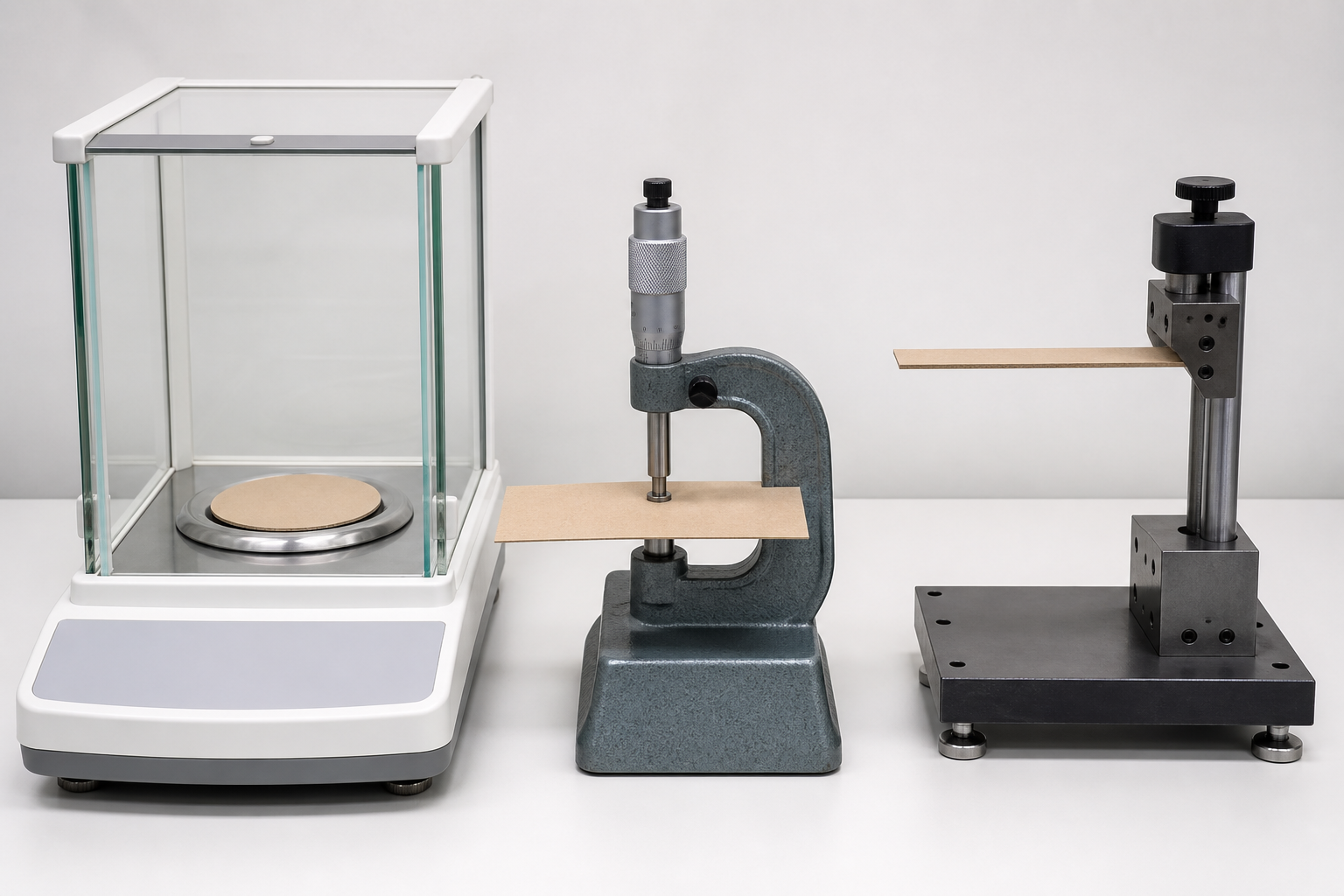
| Term | What it measures | Typical expression | What it cannot prove | Useful buyer field | | :--- | :--- | :--- | :--- | :--- | | Grammage | Mass per unit area | g/m² or GSM | Sheet thickness, bending stiffness, fold quality or finished-carton strength | Grade + nominal and tolerance + test method/condition | | Caliper | Sheet thickness under a defined measurement | µm, mm or point | Fiber composition, stiffness, compression response or carton performance | Grade + nominal and tolerance + method/load | | Bending stiffness | Resistance to bending under a stated method | Method-specific result, normally by direction | Finished carton fit, crease quality, glue, closure or packed-route performance | MD and CD + method + condition + specimen details | | Board grade | A mill's defined construction and surface specification | Manufacturer/grade/code | Suitability for every print, contact or performance requirement | Manufacturer + grade code + current technical data and lot traceability | | Converted carton | The dieline, board, print, finish, crease, glue and assembly as one pack | Revision-controlled sample and acceptance results | Future lots unless change control and acceptance rules are maintained | Drawing + BOM + sample ID + test/inspection evidence |
Exact point conversion. One point equals 0.001 inch, or 0.0254 mm. That converts a thickness unit only. It does not create an exact conversion between GSM and points. Two boards can have the same grammage and different caliper because their density, fiber mix and construction differ; two boards with similar caliper can also have different directional stiffness.
2. Folding Carton Paper Weight Begins with the Board Grade
A GSM value without a grade is an incomplete specification. Solid bleached board, folding boxboard, unbleached kraft board and recycled-fiber board can differ in furnish, layer construction, coating, bulk, shade, surface and directional behavior. Even familiar family names do not identify one universal product. Record the mill or manufacturer and commercial grade whenever continuity matters.
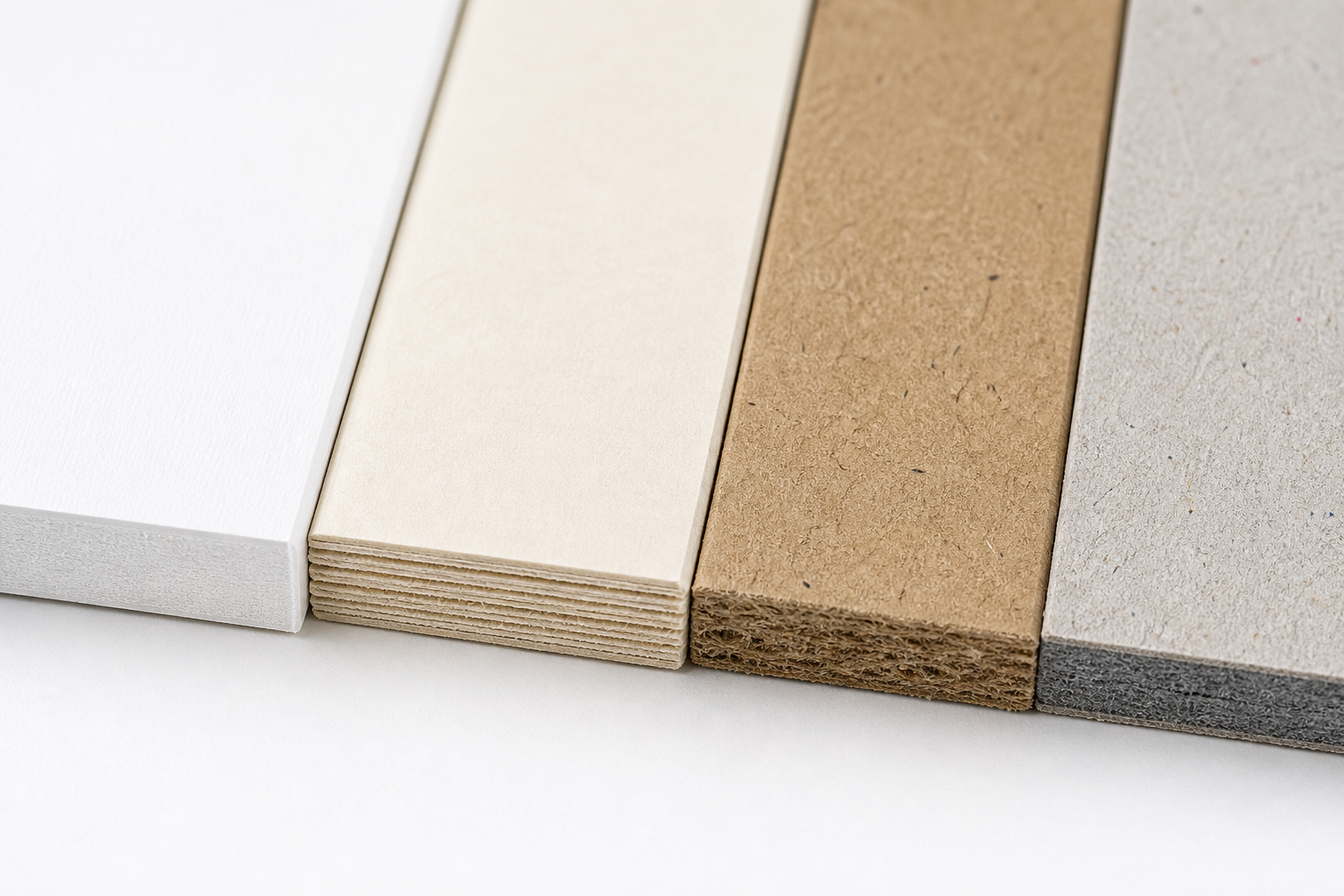
| Board family | Why buyers consider it | Do not approve without | | :--- | :--- | :--- | | SBS or solid bleached board | Clean white appearance, coated or uncoated surfaces, print and finishing options | Exact coating side, optical/visual target, grade code, stiffness, crack resistance and any contact documentation | | FBB or folding boxboard | Multi-ply construction and bulk can provide a different caliper-to-grammage balance | Availability by market, surface, grade code, MD/CD stiffness, crease behavior and substitution rules | | Kraft or unbleached board | Natural appearance and fiber visibility; coated variants also exist | Shade range, print contrast, surface consistency, grade identity and product/contact requirements | | Recycled-fiber or CCNB-type board | Recycled content and cost or print-surface options depending on grade | Back color, odor/cleanliness requirement, surface, migration/contact boundary, stiffness and lot consistency | | Specialty or barrier-treated board | A defined surface, tactile, grease, moisture or other project function | Treatment chemistry, print/glue/crease compatibility, end-market documentation, recovery route and evidence scope |
For food, supplements or other regulated products, first define whether the folding carton directly contacts the product or surrounds a sealed primary pack. "Food grade," recycled or certified-sourcing language is not a complete approval. Request the documents, scope, issuing body, dates and market-specific review that apply to the exact board, inks, coatings, adhesives and intended use.
Review current packaging material guides as orientation, then request a project-specific board specification and evidence package.
3. Size and Structure Turn Sheet Properties into Panel Behavior
The same board can feel adequate in a compact tuck carton and unstable in a taller box with broad unsupported panels. The dieline determines where the board bends, spans, carries load and loses material. Product weight belongs in the brief, but the load path and geometry explain where that weight acts.
| Structural feature | Risk created | Variables to review together | | :--- | :--- | :--- | | Long or wide panel | Bowing, oil-canning, loss of shelf appearance or case-pack pressure | Panel span, grain orientation, board grade/stiffness, ribs/folds, insert support and case packing | | Tall narrow carton | Racking, lean, closure stress or poor line handling | Base stability, product center of gravity, panel stiffness and closure design | | Large window or perforation | Removed fibers reduce panel continuity and change crease/tear behavior | Window size/location, film patch, edge distance, grain and physical sample | | Heavy or concentrated product | Bottom opening, localized deformation or product movement | Bottom style, support panel, insert, load orientation, glue/lock and handling | | Pump, cap or irregular shape | Point loads, abrasion, bulge or fit variation | Actual product range, orientation, clearance, retention and packing method | | Multiple components | Mispack, movement, uneven loading and changing SKU envelope | Component map, insert/partition, common versus variable parts and line trial | | Shelf or case stacking | Panel compression and cosmetic deformation over time | Stacking pattern, duration, environment, master case and packed-product evaluation |
Ask the structural designer to mark critical panels and load paths on the dieline. A material upgrade may be appropriate, but geometry, support and case packing can sometimes solve the same failure with less material. The preferred route must be confirmed with the exact product and manufacturing process. Explore our custom folding carton structures when the structural brief is ready to narrow.
4. Match the Decision to the Product and Channel
| Buyer context | Highest-value inputs | Critical boundary | | :--- | :--- | :--- | | Beauty and skincare | Shelf finish, panel flatness, bottle/pump fit, tactile coating, foil/embossing and batch color | Large unprinted areas, dark solid colors and multiple finishes can expose surface or fold defects; evaluate decorated cartons | | Food, coffee and supplements | Primary-pack shape, fill variation, labeling space, odor/cleanliness, case stacking and market documentation | The outer carton does not replace primary-pack barrier or seal validation; define direct-contact status | | Healthcare-style information cartons | Text legibility, variable coding, leaflet/insert, tamper features, line speed and revision control | Use applicable regulatory and quality owners; do not infer compliance from material thickness | | Large-window retail carton | Window geometry, product restraint, panel continuity, film patch and shelf deformation | A higher GSM does not automatically repair a weak cutout location or unsupported product | | Electronics and accessories | Component control, cable/charger fit, surface protection, weight concentration and returns | Separate retail carton performance from parcel or master-carton protection | | Multi-SKU program | Shared board and structure, size family, finish consistency, MOQ/inventory and substitutions | A common grade can simplify control, but each geometry and packed load still needs approval |
5. Lock Grain Direction, Conditioning and Creasing
Paperboard is anisotropic: its bending behavior differs by machine direction and cross direction. That is why a single stiffness number without direction is difficult to use. The relationship between grain and the main folds also affects crease formation, folding force, springback and cracking. Moisture and conditioning can further change the result.
| Control | What to record | Why it matters | | :--- | :--- | :--- | | Grain direction | Mark on drawing and sheet layout; return MD/CD stiffness data | Changing imposition or supplier can alter fold and panel behavior even if GSM is unchanged | | Board condition | State conditioning/test atmosphere or supplier method and protect stock in storage | Dry or humid board can respond differently during converting and approval | | Rule and matrix/channel | Record the production crease system appropriate to the exact board and finish | A generic digital score may not represent production creasing | | Fold sequence | Identify inside/outside folds, pre-breaking and automated/manual erection | The sample can pass by hand yet fail or slow the packing line | | Acceptance | Define cracking, delamination, whitening, springback and closure criteria with visual masters | Words such as "no cracking" need inspection conditions and agreed boundaries |
Iggesund's paperboard guidance describes directional stiffness and the interaction between die cutting and creasing. Use technical references to build the method, then approve the real board, tooling and decoration combination with production owners.
6. Treat Printing, Coating and Lamination as Part of the Construction
Ink, varnish, film lamination, foil, embossing, debossing, windows and glued components can change the way a carton looks, folds and runs. A laminate can add measured build and surface protection, but it does not automatically prove bending stiffness, bottom strength or shipping performance. Heavy coverage across a fold can also expose cracking or whitening that is invisible on an undecorated blank.
| Feature | Additional question | Evidence needed | | :--- | :--- | :--- | | Film lamination or coating | Surface feel, rub/moisture resistance, fold response, glue area and recovery claims | Decorated crease sample and glue/erection trial | | Foil or emboss/deboss | Placement to folds, panel distortion, fine detail and stacking pressure | Tooling proof on the specified board and final artwork | | Window and film patch | Panel continuity, patch adhesion, contact boundary and recycling claim | Converted sample with packed product and agreed handling | | Dark or heavy print coverage | Scuff, rub, fold whitening, color consistency and cure/dry conditions | Representative decorated sample, not a white structural blank | | Glue and closure | Coating-free glue areas, adhesive compatibility, open time and packing conditions | Production-equivalent assembly and line observation |
7. Compare Total System Cost, Not Board GSM
Lower grammage can reduce material use in a controlled redesign, but it can also require a support insert, slower packing, tighter process control or more protective outer packaging. Higher grammage can add cost and material without solving a poor dieline. Compare one system boundary and use real supplier, operations and quality records.
Comparable cost per usable packed unit = paperboard and conversion + decoration + tooling/sample allocation + insert or reinforcement + packing labor + case/parcel material + inbound/outbound logistics + inspection, rework and expected damage.
| Cost block | Normalize before choosing | | :--- | :--- | | Material and yield | Grade, sheet size, nesting, waste allowance, minimum order and substitution control | | Converting | Print/finish route, die cutting, creasing, stripping, gluing and line speed | | Support components | Insert, partition, window patch, label, seal, sleeve or stronger master carton | | Operations | Erection, product loading, closure, inspection, work-in-progress and mispack risk | | Distribution | Units per case, case dimensions, pallet pattern, parcel outer and damage records | | Change risk | New supplier/grade, lot variation, reapproval, obsolete stock and launch timing |
For sustainability, use the same boundary. Record board source and recycled-content evidence, total mass, yield, coatings or laminates, extra layers, logistics, damage/rework and the recovery system in the destination market. Do not claim a lighter or paper-based option is automatically better without the assumptions and evidence.
8. Build a Comparable Supplier Return Sheet
Ask every supplier to return the same fields. A proposal that says only "350 GSM white card" cannot be compared reliably with a named high-bulk or recycled grade, and it gives procurement little control over later substitution.
| Return field | Supplier must state | | :--- | :--- | | Board identity | Manufacturer/mill, commercial grade, grade code, production location where relevant, current technical data-sheet date | | Construction | Board family, ply/furnish description available from supplier, coated sides, shade/back, surface treatment | | Grammage | Nominal, tolerance, test method, condition and lot/report reference | | Caliper | Nominal, tolerance, unit, method/load, condition and lot/report reference | | Bending behavior | MD and CD stiffness or bending resistance, exact test method/instrument, specimen condition and units | | Direction | Machine direction marked on sheet layout and carton dieline; agreed relationship to critical folds/panels | | Conversion | Print, coating/lamination, foil/embossing, window, die/crease system, glue and delivery state | | Documentation | Sourcing, recycled content, restricted substances, contact or other market-specific documents with scope/date | | Tolerance and inspection | Incoming/production sampling, measurement locations, visual criteria, disposition and retention records | | Change control | No manufacturer, grade, construction, production site or material substitution without written disclosure and agreed reapproval | | Samples | Swatch, structural blank, decorated sample, pre-production sample and packed validation required for the project |
Buyer note. If two suppliers use different stiffness methods or specimen conditions, do not rank the numbers as though they were directly equivalent. Ask the technical owners to normalize the method or compare revision-matched physical samples and carton results.
9. Use a Sample Ladder Instead of One Approval Sample

| Evidence stage | Can support | Does not automatically prove | | :--- | :--- | :--- | | Board swatch and data sheet | Surface, shade, tactile response and reported sheet properties | Carton geometry, production crease, glue, decoration, fit or packed performance | | Cut/creased blank or white sample | Dieline, fit, erection, basic panel behavior and closure | Final printed surface, production material/tooling or route performance unless explicitly matched | | Decorated sample | Artwork, color/finish intent, fold appearance and unboxing on the stated sample process | Mass-production consistency or shipping performance | | Production-equivalent or pre-production sample | Specified board, decoration, die/crease, glue and assembly when the route is genuinely matched | Future lots or packed performance outside the agreed evaluation | | Packed-product and line trial | Product range, loading, closure, operator sequence, panel/insert behavior and handling | Unrepresented environmental or distribution hazards | | Distribution or stacking evaluation | The defined packed configuration under selected hazards or conditions | Every route, carrier, climate, duration or future material change |
Retain sample IDs, board lot or supplier report, dieline and artwork revisions, pack-out, test or inspection conditions, deviations, photos, approvers and reapproval triggers. If a buyer approves only a visual mockup, the supplier should state which production properties remain open.
Confirm the matched sample route under ChromaPack's structural design and sampling information, then document the project-specific scope in the quotation and approval plan.
10. Apply the Method to Common Buyer Scenarios
| Scenario | Risk brief | Evidence to prioritize | Avoid | | :--- | :--- | :--- | :--- | | Premium skincare carton | Broad front panel, glass bottle, dark print, foil and lamination | Grade/surface, panel stiffness, product restraint, decorated fold and scuff evidence | Do not solve appearance defects with GSM alone | | Supplement bottle outer carton | Bottle weight, information panels, automated or manual packing and case stacking | Bottom/closure, MD/CD behavior, line trial, coding and packed case observation | Separate material documentation from performance evidence | | Pouch or sachet carton | Flexible contents, changing fill profile, count accuracy and panel bulge | Pack-out range, insertion method, carton geometry and case support | Use real filled units, not nominal dimensions only | | Large-window food carton | Removed panel area, film patch, direct-contact boundary and shelf appearance | Window geometry, patch, grain, decorated sample and packed shelf/case check | Higher GSM may not correct poor cutout placement | | Multi-SKU beauty line | Shared visual system across several carton sizes and product masses | Common-grade feasibility, per-geometry approval, color/finish control and substitution rule | A shared GSM is not a shared performance result | | Retail plus ecommerce | Same product carton inside case distribution and parcel fulfillment | Approve the product carton and each outer shipping architecture separately | Do not treat thicker retail board as a substitute for route validation |
11. Send a Paperboard Specification Brief with the RFQ
| Brief field | Minimum information | | :--- | :--- | | Product and pack-out | SKU/revision, actual product and accessories, dimensions/range, packed weight, center of gravity, fragile/cosmetic zones and allowed movement | | Carton structure | Dieline or desired style, inside/outside dimensions, panel/window/perforation features, bottom, closure, insert and delivery state | | Channel and loads | Retail, case, pallet, parcel or mixed route; stack pattern, duration, environment and handling assumptions | | Operations | Manual/automatic erection and packing, equipment constraints, loading sequence, closure, throughput and inspection points | | Board proposal | Manufacturer/grade/code, GSM, caliper, MD/CD stiffness and methods, grain direction, surfaces, tolerances and substitution control | | Decoration | Print coverage, coating/lamination, foil/embossing, window patch, glue areas and critical fold appearance | | Evidence | Supplier data/lot record, structural blank, decorated/pre-production sample, line trial and packed validation required | | Commercial return | Quantity by SKU, forecast context, tooling/sample charges, unit price, yield/waste assumptions, master packing and freight boundary | | Approval | Measurement/visual criteria, sample IDs, named reviewers, deviations, retention and reapproval triggers |
Copyable RFQ instruction. Please propose a paperboard grade for the attached product, dieline and pack-out. Return the board manufacturer and commercial grade/code, nominal grammage and caliper with tolerances and test methods, MD/CD stiffness data and method, grain direction, surface construction, print/finish route, die/crease and glue assumptions, delivery state, substitution rule and sample/validation plan. Explain any deviation from this brief. Do not replace these fields with a generic GSM-to-point conversion or a product-weight chart.
Frequently Asked Questions
Is 350 GSM paperboard strong enough for my folding carton? It cannot be confirmed from GSM alone. Supply the named grade, carton dimensions and structure, product pack-out, grain direction, finishes, closure, packing process and route. Compare directional data and validate the converted carton.
Can I convert paperboard GSM to points exactly? No universal conversion exists across board grades. Points express caliper: 1 point is 0.001 inch or 0.0254 mm. GSM expresses mass per area. Density and construction determine the relationship.
Is thicker paperboard always stiffer? Not necessarily. Caliper and bending stiffness are different properties, and stiffness differs by machine and cross direction. Use the named grade, comparable test method and converted sample.
Why do two 350 GSM boards feel different? They may have different fiber furnish, ply construction, bulk, density, coating, moisture, grain orientation or manufacturing tolerances. Ask for grade-specific data and samples.
Does lamination make a folding carton stronger? It can change surface behavior and measured build, but it does not by itself prove stiffness, bottom strength or shipping performance. Evaluate the exact laminated and creased carton.
What board should I use for a cosmetic box? Start with product mass and shape, carton geometry, shelf finish, print/foil/lamination, pack-out, case or parcel route and approval criteria. Then compare named grades through decorated samples.
What sample confirms the paperboard choice? No single early sample confirms everything. Use a ladder from board data and swatch to structural, decorated, production-equivalent and packed evidence as the project risk requires.
Can I use one paperboard grade across all SKUs? Possibly, but approve each geometry and packed load. A common grade can simplify sourcing and appearance while still producing different panel, fold and closure behavior by size.
What happens if the supplier changes the board mill or grade? Treat it as a controlled change. Require written disclosure, updated data, impact review and the agreed level of resampling or validation before production.
First-Party Evidence ChromaPack Adds to Each Project
- A photographed set of current named board grades with supplier data sheets, measured caliper records and clearly marked machine direction. Values are published only with method, condition, tolerance and date.
- One controlled comparison showing boards with similar GSM but different caliper or stiffness, or similar caliper but different directional behavior. If such a matched comparison is unavailable, numerical results are omitted.
- A real carton-geometry comparison using the same verified board lot, with dimensions, window/opening, product pack-out and observed panel or closure behavior recorded.
- Matched production crease samples showing accepted and rejected visual boundaries, tied to board, finish, tooling and inspection conditions.
- One anonymized multi-SKU or redesign case showing the decision record, sample sequence and outcome.
- A current capability matrix stating which board families, measurements, converting routes and sample types ChromaPack performs directly or coordinates externally.
- Real FAQ language from quote requests, sales chats, sample revisions or nonconformance records, anonymized and grouped by buyer role.
Specify the Board and the Finished Carton Together
Send the product and complete pack-out, carton dimensions or dieline, packed weight, quantity by SKU, display and distribution route, stack and packing method, finish requirements, target market and acceptance priorities. ChromaPack can use that brief to compare practical board grades, identify missing evidence and define the structural, decorated and production-equivalent samples needed before approval.
Send the Board Specification Brief — include your product, dieline or dimensions, pack-out, quantity by SKU, target channel and distribution route, and we will return a comparable board specification with the sample plan your project needs.
Authoritative Sources and Validation Links
- ISO 536:2019 — Paper and board: Determination of grammage. Official grammage test-method reference; it does not convert GSM into carton performance.
- ISO 534:2011 — Paper and board: Determination of thickness, density and specific volume. Official thickness-method reference under specified loading; it does not provide a universal GSM-to-caliper conversion.
- ISO 5628:2019 — Paper and board: Determination of bending stiffness. Official overview of bending-stiffness methods and the need to identify the method used.
- Paperboard Packaging Council — Pick Paperboard Like a Pro. Industry explanation of caliper, basis weight and grammage terminology.
- Paperboard Packaging Council — The Properties of Paperboard. Industry overview including machine- and cross-direction stiffness.
- Iggesund — Paperboard stiffness. Technical explanation of anisotropy and MD/CD behavior.
- Iggesund — Die-cutting and creasing. Technical discussion of production creasing and converting interactions.
- ChromaPack — Custom box structures and quality and sampling. Current product-page context for materials, structural options and project intake.
Source-use note: standards and technical references support definitions and test principles. They do not validate available grades, tolerances, carton performance, contact suitability, sustainability results, prices, lead times or customer outcomes. Those claims require current first-party evidence.