
Custom Packaging RFQ Template: 18 Specifications Buyers Should Send Before Quoting
July 2026 • 12–14 min read • By ChromaPack Engineering Team • Last reviewed: July 27, 2026
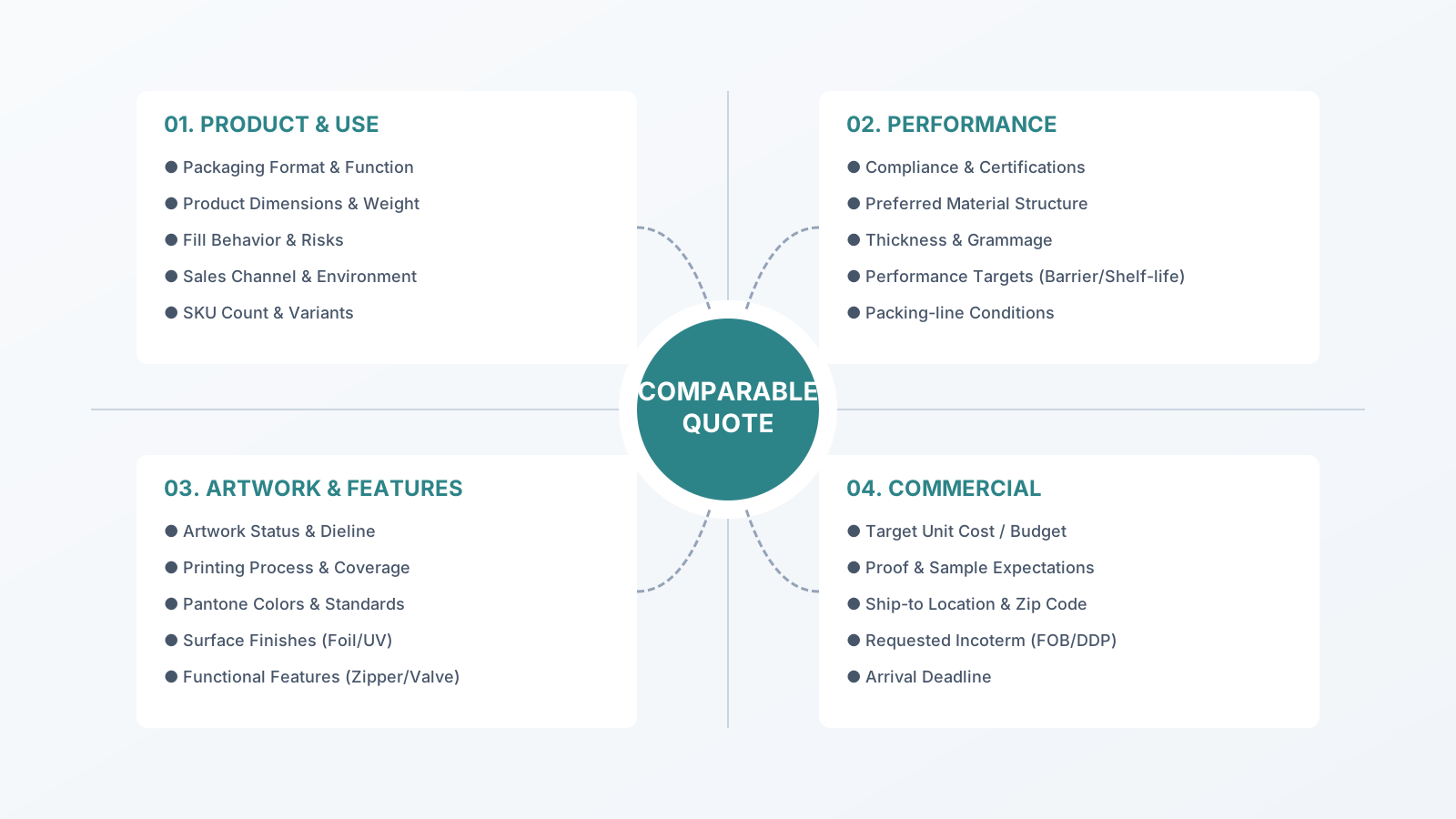
Short answer: to receive an accurate, comparable custom packaging quote, send the supplier your product details, packaging format, dimensions, quantity by SKU, target market, performance needs, material preferences, artwork and color requirements, finishes, functional features, sample expectations, budget, delivery destination and requested trade term. If you do not know a technical parameter, state the performance outcome you need and ask the supplier to recommend the structure—do not leave the field blank.
The practical rule: A useful RFQ separates facts you own—product size, fill weight, sales market, quantity and deadline—from engineering decisions the packaging supplier can recommend. That produces a faster quote without forcing you to guess at film structures, board grades or print processes.
Why incomplete packaging RFQs create misleading prices
“How much does custom packaging cost?” sounds like a simple question, but a unit price only has meaning when the scope is defined. A 250 g coffee pouch with a one-way valve, high-barrier laminate and matte finish is not comparable to a same-size snack pouch made from a simpler structure. A rigid gift box quote can move materially when the greyboard thickness, insert, closure, wrap paper or finishing method changes.
When buyers send only a reference photo and a quantity, suppliers have to make assumptions. One supplier may quote the lowest workable specification, another may include stronger materials and export packing, and a third may exclude tooling, freight or testing. The three prices look comparable in a spreadsheet, but they describe three different products.
A good RFQ does not need to be an engineering drawing. It needs enough structured information for the supplier to identify unknowns, recommend a fit-for-purpose construction and return a quote whose inclusions can be checked line by line.
The 18 specifications to include in a custom packaging RFQ
Use the fields below as a working brief. For an early budget quote, some answers can be ranges. Before sampling or purchase order approval, convert every assumption into a written specification.
1. Packaging format and intended function
Name the format first: stand-up pouch, flat-bottom coffee bag, folding carton, rigid set-up box, paper bag, mailer box, label, molded insert or another structure. Then explain what the packaging must do—contain, protect, preserve, display, ship, dispense or create a premium unboxing experience.
RFQ note: Write it like this: “Resealable stand-up pouch for 500 g roasted coffee beans, retail shelf use, one-way degassing valve required.”
2. Product details: dimensions, weight and risk factors
Describe the product going inside the package. Provide its maximum length, width and height, net or fill weight, material, shape and whether it is fragile, sharp, oily, aromatic, moisture-sensitive, light-sensitive, static-sensitive or temperature-sensitive.
RFQ note: Why it changes the quote: product weight and risk determine board strength, film barrier, seal design, insert material, drop protection and testing.
3. Required package dimensions—and what those dimensions mean
State whether your dimensions are internal, external, flat size or finished size. Use a consistent order such as L × W × H for boxes, and W × H + bottom gusset for stand-up pouches. For paper bags, specify width × gusset × height. Include the unit: mm or inches.
RFQ note: Avoid: “Box size 120 × 80 × 40” with no indication of internal or external dimensions.
4. SKU count and what changes between variants
State the total number of SKUs and identify what changes: artwork only, dimensions, material, flavor name, barcode, language or finish. A 10,000-unit order split across five artworks is not normally priced like one 10,000-unit artwork because setup, plates, cylinders, color control and packing may repeat for each SKU.
5. Sales channel, use environment and target market
Tell the supplier where and how the package will be used: retail shelf, e-commerce parcel, subscription kit, refrigerated display, warehouse storage, export shipment, medical environment or food-service operation.
6. Compliance and documentation requirements
List any requirements that apply to the actual application, such as food-contact documentation, migration testing, FSC chain-of-custody claims, sterile barrier validation, restricted-substance declarations or retailer-specific testing.
7. Preferred material—or permission for the supplier to recommend it
If you already have an approved material, specify the substrate and construction: for example, SBS paperboard, kraft paper, E-flute corrugated board, 2 mm greyboard, mono-PE film or PET/AL/PE laminate.
8. Thickness, grammage, board grade, flute or performance target
Material name alone is not enough. Ask the quote to show the relevant measurable specification: film thickness in microns, paper grammage in GSM, greyboard thickness in millimetres, corrugated flute profile, or another agreed grade.
9. Filling, sealing and packing-line conditions
For pouches and flexible packaging, explain whether filling is manual or automatic, the filling temperature, sealing equipment, and required zipper/valve/spout.
10. Artwork status, dieline and file format
Tell the supplier whether you have final artwork, an existing dieline, an editable design file, only a logo, or no artwork yet.
11. Print coverage, process, colors and color standard
Specify whether printing is one side or two sides, inside or outside, full coverage or limited panels. List CMYK process colors, Pantone spot colors, white ink, or metallic ink.
12. Surface finishes and special effects
List matte or gloss lamination, soft-touch coating, spot UV, foil stamping, embossing, debossing, or other finishing.
13. Functional features, closures and accessories
Identify every functional component: zipper, tear notch, hang hole, degassing valve, spout, window, handle, magnet, ribbon, pull tab, divider or insert.
14. Order quantity by SKU and expected reorder pattern
Give a realistic quantity per SKU and ask for two or three useful price breaks rather than an unlimited price ladder.
15. Target unit cost or budget range
A budget is not an invitation to charge the maximum. It tells the engineering team which trade-offs are realistic.
16. Proof and sample expectations
Define what you need before mass production: 3D mockup, digital proof, stock material/finish sample, white structural prototype or printed production sample.
17. Required delivery date, ship-to location and Incoterm
Provide the requested arrival date and include the destination city, postal code and country. State whether the quote should be EXW, FOB, CIF, DAP or DDP.
18. Quote format, packing details and commercial assumptions
Tell suppliers how to return the quote so you can compare it. Request the same line items from each supplier for normalization.
Copy-and-paste custom packaging RFQ template
Copy this structure into an email, spreadsheet or procurement system. Replace brackets with your information and attach product drawings, artwork and reference photos where available.
| No. | RFQ Field | What to enter |
|---|---|---|
| 1 | Project / Company | Company, contact, project name, new launch or reorder |
| 2 | Packaging Format | Pouch, carton, rigid box, paper bag, mailer, label, insert, etc. |
| 3 | Product Inside | Dimensions, weight/fill weight, material, fragility and sensitivities |
| 4 | Finished Package Size | Internal/external/flat/finished dimensions with units |
| 5 | SKU Structure | Number of SKUs; what changes; quantity per artwork |
| 6 | Use & Sales Market | Retail/e-commerce/storage conditions; destination countries |
| 7 | Compliance | Food contact, FSC, medical, retailer or other documentation/testing |
| 8 | Material | Approved construction or “supplier recommendation requested” |
| 9 | Performance Target | Barrier, shelf life, drop/compression, seal, puncture or load requirement |
| 10 | Packing-line Conditions | Manual/automatic filling, temperature, sealing/assembly equipment |
| 11 | Artwork & Dieline | Artwork status, file format, dieline status and design support needed |
| 12 | Printing & Color | Sides/coverage, CMYK/Pantone/white ink, approved color reference |
| 13 | Finishes | Matte/gloss/soft-touch, foil, UV, emboss, varnish, texture |
| 14 | Features & Accessories | Zipper, valve, window, handle, magnet, ribbon, insert, etc. |
| 15 | Quantity & Forecast | Initial quantity and 2–3 useful price breaks; reorder frequency |
| 16 | Budget | Target unit/landed cost; state what is included |
| 17 | Proof / Sample | Mockup, stock, structural or printed sample; approval criteria |
| 18 | Delivery & Quote Basis | Arrival date, full ship-to, Incoterm/place, required quote line items |
Two completed RFQ examples
Example A: Printed coffee pouch
- Project: 250 g roasted coffee beans for retail and e-commerce in the United States.
- Format: flat-bottom bag with resealable zipper and one-way degassing valve.
- Material: High-barrier structure required for a 9-month shelf life.
- Logistics: Quote FOB Shenzhen and DDP to Oregon, USA.
Example B: Rigid cosmetic box with insert
- Project: retail presentation box for a 50 ml glass skincare bottle.
- Construction: 2 mm greyboard wrapped with printed paper.
- Insert: Paperboard or molded pulp preferred.
- Logistics: Quote EXW and DDP to Manchester, UK.
Send a quote-ready packaging brief
A complete RFQ does more than accelerate pricing. It creates a shared specification that can move through design, sampling, approval, purchasing, quality control and repeat orders without losing the original requirements.
Send Your RFQ → Share your product, quantity, target market and delivery requirement. ChromaPack will return a proposed packaging specification and itemized quotation for review.