
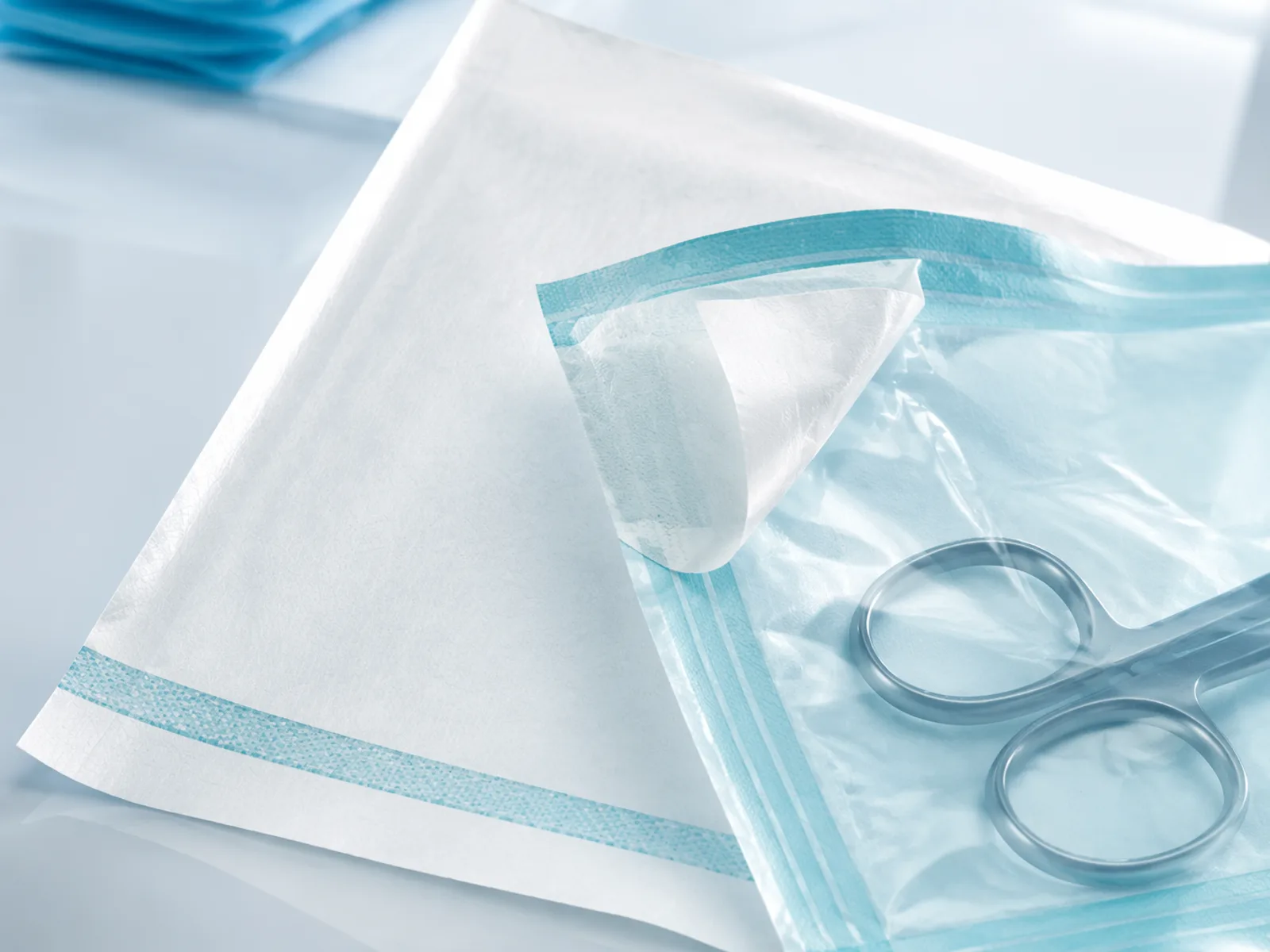
Medical Packaging
Tyvek Sterile Pouches Guide: Grades, Sealing & Validation for Medical Devices
May 2026 8 min read By ChromaPack Engineering Team
Why Tyvek Sterile Pouches Matter in Medical Device Packaging
For medical device manufacturers, packaging is not simply a protective cover. It is part of the sterile barrier system that helps maintain product sterility from the sterilization process to final clinical use.
Learn more about our medical sterile packaging options and see our ISO 11607 compliance guide for details.
This is where Tyvek sterile pouches are widely used.
Tyvek is a high-density polyethylene flash-spun nonwoven material. Compared with ordinary medical paper-plastic pouches, Tyvek offers stronger resistance to tearing and puncture, better microbial barrier performance, and broader compatibility with common sterilization methods such as EO, gamma irradiation, and selected steam sterilization processes.
For many medical devices, especially sharp, rigid, or high-value products, ordinary medical paper may not provide enough protection during handling, shipping, and storage. A small fiber tear, seal failure, or puncture can compromise the sterile barrier and create serious compliance risks.
A simple way to understand Tyvek is this: It is a material that breathes without compromising the sterile barrier.
This balance is why Tyvek is often chosen for medical devices that require reliable sterilization, clean peeling, and long-term package integrity.
For buyers sourcing from a medical pouch supplier in China, the key question is not only "Can you make Tyvek pouches?" but also "Can you support the right material grade, sealing structure, test data, and validation documents for my device?"
Tyvek 1073B vs 1059B: Which Material Should You Choose?
One of the most common questions from medical device buyers is the difference between Tyvek 1073B vs 1059B.
Both are used in sterile medical packaging, but they are not interchangeable for every application. Choosing the wrong Tyvek grade may lead to unnecessary cost, insufficient mechanical protection, or sterilization compatibility issues.
| Comparison Point | Tyvek 1073B | Tyvek 1059B |
|---|---|---|
| Material Strength | Thicker, higher tear and puncture resistance | Lighter, more economical |
| Cost Level | Higher | Lower |
| Sterilization Compatibility | EO, gamma, selected steam applications | Mainly EO sterilization packaging |
| Typical Applications | Surgical instruments, implants, rigid or sharp devices | General disposable medical supplies, catheters, light devices |
| Best For | High-risk or high-value devices | Cost-sensitive standard medical consumables |
When to Use Tyvek 1073B
Tyvek 1073B is generally preferred when the device has higher packaging risk. This includes products with sharp edges, heavier components, rigid structures, or higher regulatory requirements.
Typical applications include:
-
Surgical instruments
-
Orthopedic or dental tools
-
Implant-related devices
-
Diagnostic kits with rigid components
-
Medical devices requiring stronger puncture resistance
-
Products that may go through gamma or more demanding sterilization processes
If the pouch may face higher mechanical stress during loading, sealing, sterilization, shipping, or hospital handling, Tyvek 1073B is usually the safer option.
When to Use Tyvek 1059B
Tyvek 1059B is more suitable for lighter, cost-sensitive medical products, especially where EO sterilization is the main sterilization method.
Typical applications include:
-
Catheters
-
Tubing sets
-
Disposable medical accessories
-
Lightweight sterile consumables
-
Small non-sharp medical components
For standard medical consumables, Tyvek 1059B may offer a good balance between performance and cost. However, buyers should still confirm seal strength, peel performance, and microbial barrier data based on the actual pouch structure.
Simple Procurement Decision Tree
-
Use Tyvek 1073B if your device is sharp, rigid, heavy, implant-related, high-value, or requires stronger mechanical protection.
-
Use Tyvek 1059B if your device is lightweight, non-sharp, mainly EO sterilized, and cost control is important.
When in doubt, ask your supplier for test samples using both materials and compare seal strength, peeling behavior, puncture resistance, and sterilization results before confirming mass production.
Packaging Compatibility with EO, Gamma, and Steam Sterilization
Sterilization method is one of the most important factors in sterile pouch sourcing. A pouch that performs well under EO sterilization may not automatically be suitable for gamma irradiation or steam sterilization.
EO Sterilization Packaging
EO sterilization is one of the most common methods for medical devices. It requires packaging materials with good breathability, allowing sterilant gas to enter and exit the package effectively.
Tyvek performs well in EO sterilization because its structure allows gas penetration while maintaining microbial barrier performance.
For many medical device manufacturers, EO sterilization packaging is the most practical and flexible choice, especially for temperature-sensitive devices, plastic components, tubing, and complex assemblies.
Gamma Sterilization Packaging
Gamma irradiation does not require gas permeability in the same way as EO, but it places different demands on packaging materials.
One common concern is color change. Some materials may show yellowing after gamma exposure. When using Tyvek for gamma sterilization, buyers should confirm whether the material grade, film layer, printing ink, and adhesive system are compatible with the required radiation dose.
For export-oriented medical packaging, it is important to ask for gamma compatibility data or previous project references.
Steam Sterilization Packaging
Steam sterilization involves high temperature and moisture. Not all Tyvek pouch structures are suitable for steam.
If steam sterilization is required, the buyer should confirm whether the Tyvek grade, film structure, coating, sealant layer, and pouch design have been tested under the intended cycle conditions. In general, higher-strength Tyvek structures are more commonly considered for demanding steam-related applications, but final suitability must be validated by testing.
| Sterilization Method | Recommended Tyvek Direction | Packaging Suggestion |
|---|---|---|
| EO Sterilization | Tyvek 1059B or 1073B | Ensure good breathability, stable seal strength, and clean peel |
| Gamma Sterilization | Usually Tyvek 1073B for higher-risk devices | Confirm yellowing, ink stability, film compatibility, and radiation dose |
| Steam Sterilization | Higher-strength Tyvek structures only after validation | Confirm heat resistance, seal integrity, and post-sterilization pouch performance |
Key Quality Indicators and Compliance Documents
When sourcing Tyvek sterile pouches, price should never be the only deciding factor. The most important question is whether the pouch can support your sterile barrier system requirements.
A reliable supplier should be able to discuss not only material type and pouch size, but also test data, validation support, batch traceability, and compliance documentation.
1. Seal Strength
Seal strength is a basic but critical performance indicator. A weak seal may open during sterilization, transportation, or storage. A seal that is too strong may cause fiber tear or difficult peeling during clinical use.
For many medical pouch projects, buyers may use a reference benchmark such as ≥ 1.5 N/15mm, but the final acceptance standard should be confirmed according to the device, pouch material, sealing process, and ISO 11607 validation requirements.
The goal is not only "strong sealing," but controlled, stable, and peelable sealing.
2. Microbial Barrier Performance
A sterile barrier system must protect the device from microbial contamination. For Tyvek medical packaging, buyers may request microbial barrier testing data, such as testing based on ASTM F1608 or other relevant methods.
This is especially important for devices with longer shelf-life requirements or products shipped across long supply chains.
3. Seal Integrity Validation
Seal integrity is often more important than buyers realize. A pouch may look visually acceptable but still have channel leaks, weak areas, or inconsistent sealing.
That is why medical device manufacturers should request seal integrity validation data, not just material certificates.
Expert sourcing tip: When sourcing from China, always request the seal integrity validation report — not just the material certificate. A material certificate proves what material is used. A seal integrity report helps prove whether the finished pouch structure performs as a sterile barrier package.
4. Aging Test: Accelerated Aging vs Real-Time Aging
Shelf life is another critical issue. Many medical devices require validated packaging stability over 2, 3, or even 5 years.
Accelerated aging tests are often used to estimate long-term performance, while real-time aging provides stronger long-term evidence. For new projects, buyers should discuss both options with the supplier and testing laboratory.
5. Batch Documents: CoC and CoA
For every production batch, buyers should request:
-
Certificate of Conformance (CoC)
-
Certificate of Analysis (CoA)
-
Material traceability records
-
Production batch information
-
Inspection report
-
Sterilization compatibility data if available
For regulated medical device manufacturers, these documents are not optional. They are part of supplier control and quality traceability.
Custom Sourcing Guide for Tyvek Sterile Pouches
A practical sourcing process starts with the device itself. Before asking for a quote, buyers should prepare the device size, sterilization method, sealing method, order quantity, printing requirements, and compliance expectations.
How to Calculate Pouch Size
A simple starting formula is:
-
Minimum pouch length = device length + 20mm
-
Minimum pouch width = device width + 15mm
This is only a basic estimate. The actual size should also consider device thickness, loading direction, sealing area, easy peeling, and whether the device may shift inside the pouch during transportation.
For irregular or sharp devices, more allowance may be required.
Peelable Pouch vs Heat-Seal Pouch
There are two common pouch styles:
-
Peelable Tyvek pouch — Designed for easy opening by the end user. Commonly used for sterile medical devices that need clean presentation in hospitals, clinics, or laboratories.
-
Heat-seal Tyvek pouch — Requires sealing equipment during packing. Suitable for manufacturers who pack devices in-house and need better control of the final sealing process.
For medical device manufacturers, heat-seal pouches often provide more process control, while pre-made peelable pouches offer convenience and consistency for certain applications.
Printed Pouches vs Blank Pouches
MOQ is usually different for printed and blank pouches.
-
Blank Tyvek sterile pouches normally have lower MOQ and faster delivery. Suitable for early-stage testing, validation, small-batch production, or urgent orders.
-
Printed Tyvek pouches usually require higher MOQ because of printing setup, plate cost, ink control, artwork confirmation, and production preparation. Better for stable mass-production projects.
If the buyer is still in the product development or validation stage, it is often smarter to start with blank samples first, then move to printed production after size and structure are confirmed.
Case Reference: 10,000 PCS × 35×65mm Inquiry
For example, if a buyer requests 10,000 PCS of 35×65mm Tyvek sterile pouches, the supplier should not quote only a unit price.
A professional quotation should clarify:
-
Tyvek grade: 1073B or 1059B
-
Film structure and thickness
-
Sterilization method: EO, gamma, or steam
-
Seal type: peelable or heat-seal
-
Printing requirement: blank or custom printed
-
Whether tooling or mold cost is required
-
How tooling cost can be shared or refunded in future bulk orders
-
Lead time for samples and mass production
-
Available test reports and batch certificates
For small custom pouch sizes, tooling or setup cost may be involved. Instead of treating this as a hidden cost, a reliable supplier should explain how it is calculated and whether it can be amortized across larger future orders.
Common Mistakes When Buying Tyvek Sterile Pouches
Mistake 1: Thinking All Tyvek Materials Are the Same
Tyvek is not a single universal material. Different grades have different strength, cost, and sterilization suitability.
The difference between Tyvek 1073B vs 1059B matters. Choosing only by price may lead to performance issues, especially for sharp or high-value devices.
Mistake 2: Choosing the Lowest Price
Low-cost pouches may look similar in photos, but problems often appear during sealing, sterilization, peeling, or aging.
Common risks include:
-
Seal layer delamination
-
Inconsistent peeling
-
Weak seal strength
-
Fiber tear
-
Poor film clarity
-
Ink transfer after sterilization
-
Package failure during transport
For medical packaging, the cheapest option can become the most expensive if validation fails or shipment is delayed.
Mistake 3: Only Asking for Material Certificates
A material certificate is important, but it is not enough.
Buyers should also ask for finished pouch performance data, including seal strength, seal integrity, microbial barrier information, aging test support, and batch inspection records.
Mistake 4: Assuming Chinese Suppliers Cannot Make High-End Medical Packaging
This is outdated. Many medical packaging manufacturers in China now support international medical device companies and understand ISO 11607, FDA-related requirements, MDR expectations, cleanroom production, and export documentation.
The key is supplier selection. Buyers should evaluate whether the factory has real medical packaging experience, not just general plastic pouch production experience.
A qualified medical pouch supplier in China should be able to discuss sterile barrier systems, validation support, material traceability, and sterilization compatibility in detail.
What to Ask Before Placing an Order
Before confirming a Tyvek sterile pouch supplier, buyers should ask the following questions:
-
Which Tyvek grade do you recommend for my device, and why?
-
Is the pouch designed for EO, gamma, or steam sterilization?
-
Can you provide seal strength test data?
-
Can you provide seal integrity validation support?
-
Do you offer CoC and CoA for each batch?
-
Can you support accelerated aging or real-time aging requirements?
-
What is the MOQ for blank pouches and printed pouches?
-
Can you provide samples for validation before bulk production?
-
Is the production environment suitable for medical packaging?
-
Can you support export documentation for regulated markets?
The supplier's answers will usually reveal whether they are a true medical packaging partner or only a general packaging converter.
Final Recommendation
Tyvek sterile pouches are widely used because they combine breathability, microbial barrier performance, puncture resistance, and sterilization compatibility. But the correct sourcing decision depends on device risk, sterilization method, pouch structure, seal performance, and validation requirements.
For standard EO sterilized disposable devices, Tyvek 1059B may be sufficient and cost-effective. For surgical instruments, implants, sharp devices, gamma sterilization, or higher-risk packaging, Tyvek 1073B is often the better choice.
When sourcing from China, do not evaluate suppliers only by unit price. A reliable supplier should help you select the right Tyvek grade, confirm the sterile barrier system, provide test data, support validation, and deliver consistent batch documentation.
If you are developing a new medical device package or comparing Tyvek pouch options, our team can help review your device size, sterilization method, and packaging requirements before quotation.
Need Compliant Sterile Packaging? Get free samples with test data, or request a compliance-ready quote for your medical device packaging.
Request Compliance Quote Get Free Samples