
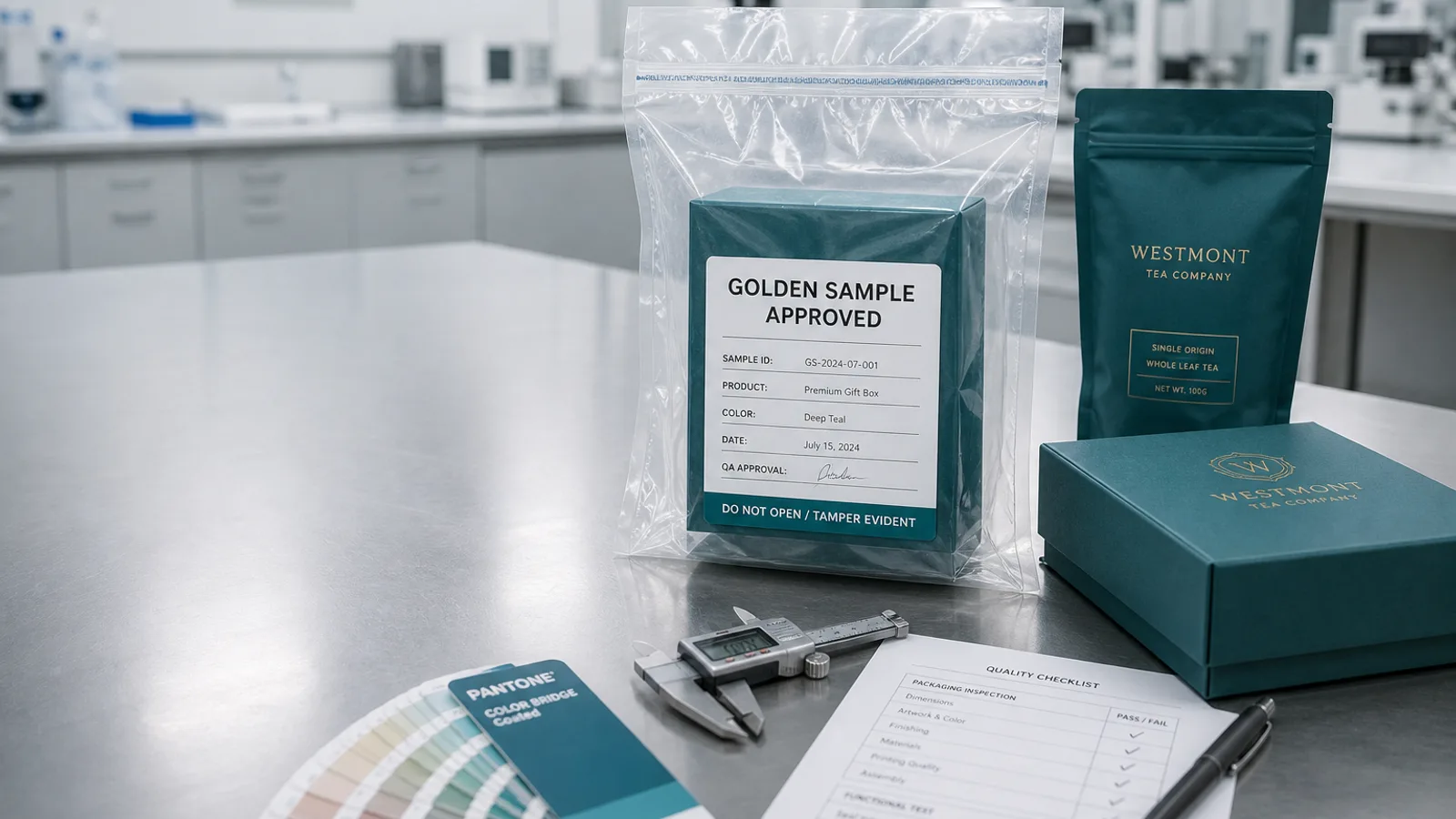
Golden Sample Approval Checklist for Custom Packaging Mass Production
July 2026 • 13–15 min read • By ChromaPack Engineering Team • Last reviewed: July 30, 2026
Short answer: a Golden Sample is a uniquely identified physical package approved as the reference for mass production. Approval is useful only when the sample is linked to the frozen artwork, dieline, material specification, components, finishes, tolerances, test requirements and a signed approval record. An email saying “looks good” does not create a complete quality standard.
The rule to remember: You are not approving an impression. You are freezing a defined, traceable specification. Any property that was not represented, measured or separately tested remains outside the sample's evidence.
Why an attractive sample can still fail as a production standard
The most expensive sampling mistake happens after a buyer receives a beautiful package. The color feels right, the foil looks clean and the product fits, so someone replies “approved.” Weeks later, the bulk order arrives with a different board feel, a darker print, looser corners or inconsistent seals.
This gap is common because a prototype and a production run may use different equipment, materials or labor. A digitally printed sample may not predict offset or gravure color. A hand-wrapped rigid box may be more precise than line output.
Which sample should become the Golden Sample?
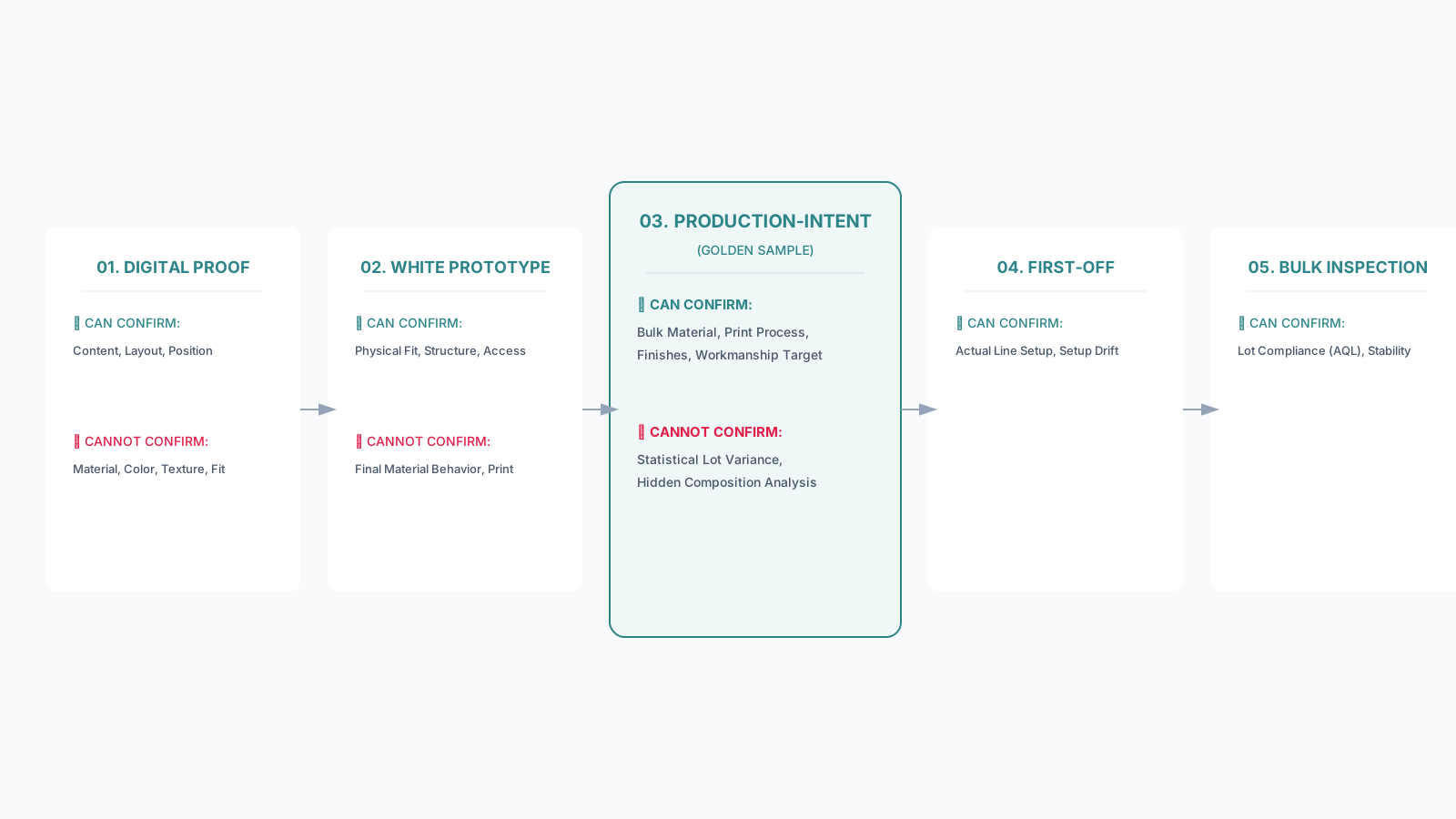
| Sample Stage | Useful for Approval | Do not assume it proves | |---|---|---| | Digital Artwork Proof | Content, graphics, layout, and position | Material, actual print color, fit, or seal | | White Structural Prototype | Shape, assembly, product fit, and access | Printed appearance or production tolerances | | Printed Prototype | General design direction and appearance | Final bulk material behavior or line output | | Production-Intent Sample | Closest pre-production reference | Statistical lot variance or hidden performance | | First-off Production Sample | Actual line setup and setup drift | A substitute for final lot inspection |
The strongest Golden Sample is normally a production-intent sample or an approved first-off unit made with the intended substrate and print process.
What a Golden Sample controls—and what needs separate evidence
A retained package is excellent visual and tactile evidence, but it cannot demonstrate hidden material composition or statistically control an entire lot.
| Attribute | Primary Control Evidence | |---|---| | Visible Structure | Golden Sample + dimension/specification record | | Artwork & Copy | Approved artwork/dieline revision + Golden Sample | | Color | Physical reference + named standard + substrate context | | Material Identity | Written material spec + supplier declaration | | Compliance | Applicable laboratory report and regulatory review | | Performance | Defined test methods (Seal, Drop, Burst tests) |
The 18-point Golden Sample approval checklist
A. Identity and Revision Control
- Sample Identity: Assign a unique ID, buyer, project, SKU, and date.
- Artwork & Dieline Revision: List exact filenames and revisions.
- Production Representativeness: Record if the sample is digital, hand-finished, or production-intent.
B. Structure, Material and Product Fit
- Dimensions & Method: Define internal vs. external and the measuring tools used.
- Material Construction: Confirm layers, board weight, film thickness, and coatings.
- Product Fit & Orientation: Load the actual sellable product and check insertion force.
- Assembly & Usability: Test closure, zippers, magnets, and tamper features.
C. Artwork, Print and Surface Appearance
- Copy & Symbols: Proofread every panel for product name, warnings, and recycling marks.
- Barcode & Data: Confirm GTIN and QR code quiet zones and readability.
- Color Standard: Record the substrate, white ink, and agreed viewing light.
- Print Execution: Check registration, sharpness, and small-text clarity.
- Finishes & Decoration: Confirm foil, spot UV, and embossing adhesion and location.
D. Function, Packing Line and Performance Evidence
- Functional Components: Operate valves, spouts, and zippers repeatedly.
- Packing-line Trial: Run the package with the real product and filling equipment.
- Performance Evidence: Link the record to seal, leak, and drop test evidence.
E. Mass-production Acceptance and Sign-off
- Workmanship & Defect Boundaries: Define critical, major, and minor defects.
- Tolerances: Record measurable limits for dimensions and registration.
- Signatures & Retention: Formally sign the record and seal duplicate retained samples.
Golden Sample approval record template
Copy the following fields into your supplier approval form:
| Record Section | Fields to Capture | |---|---| | Project Control | Buyer, Supplier, SKU, Intended Market | | Sample Control | ID, Type, Date, Production Method | | File Control | Artwork Filename/Rev, Dieline Rev, Spec Rev | | Measured Results | Defined Dimensions, Color Reference, Finish Position | | External Evidence | Material Declaration, Compliance/Performance Report IDs | | Approval Decision | Approved / Approved with Conditions / Rejected | | Retention | Buyer/Supplier sample locations, Seal ID |
From sample approval to shipment release
- Freeze the Master Record: Combine the sample ID and approved files.
- Brief Production & QC: Translate approval into work instructions.
- Verify First-off Output: Resolve setup drift before the full run continues.
- Control In-process: Check high-risk attributes at defined stages.
- Inspect the Finished Lot: Use the agreed defect classification (ISO 2859-1).
- Release & Retain Records: Keep history for claims and reorders.
Seven approval mistakes that create disputes
- Approving from screen only (uncalibrated colors).
- Approving an unexplained handmade sample.
- Using filenames such as
final-final-v4. - Checking color without material and light context.
- Treating a phone barcode scan as verification.
- Leaving acceptable variation (tolerances) undefined.
- Changing one detail after approval without re-review.
Request a Production-Intent Sample → ChromaPack can review your specification, build the appropriate sample stage, and prepare a traceable approval record before mass production.